It’s 98 degrees outside, your swamp cooler is humming away on the roof, and the house still feels like an oven. Frustrating, right? Before you assume the unit is dead and brace for a big repair bill, take a breath. Most “broken” swamp coolers in Albuquerque fall into one of two buckets: a simple mechanical fix you can handle yourself, or monsoon humidity that no repair on earth will solve.
This guide walks you through seven checks, easiest first, so you can pinpoint the problem fast and know exactly when it’s time to call a tech.
Key Takeaways
- A swamp cooler that runs but won’t cool usually has dry or clogged pads, a low water level, a failing pump, or no air-escape path.
- In dry air an evaporative cooler can drop temperatures 15–40°F, but it loses that power as humidity rises — the U.S. Department of Energy’s Building America program notes these coolers work best in dry climates and that high humidity reduces their performance (DOE Building America) — a real problem during Albuquerque’s mid-June–September monsoon (NWS Albuquerque).
- Open a window or door near each running cooler; without somewhere for the air to go, cooling stalls.
- Pad, water, and airflow issues are DIY. Pump, motor, capacitor, and float-valve repairs need a professional.
Why Is My Swamp Cooler Running but Not Cooling?
If your cooler runs but the air feels weak or warm, the cause is almost always one of four things: dry or worn pads, a low water level or failed pump, blocked airflow, or high outdoor humidity. Dirty, clogged pads are one of the most common culprits — the U.S. Department of Energy’s Building America program says to replace torn, worn, or mildewed pads (DOE Building America). The trick is to rule out the easy stuff first.
Here’s the thing about evaporative coolers: they don’t use refrigerant like a central AC. They cool by pulling warm, dry air through water-soaked pads, and that evaporation drops the temperature. When any link in that chain breaks — the water, the pads, or the airflow — cooling drops with it. Work through the checks below in order. You’ll likely find your answer in the first three.
Check 1 — Are Your Cooling Pads Dry, Clogged, or Worn?
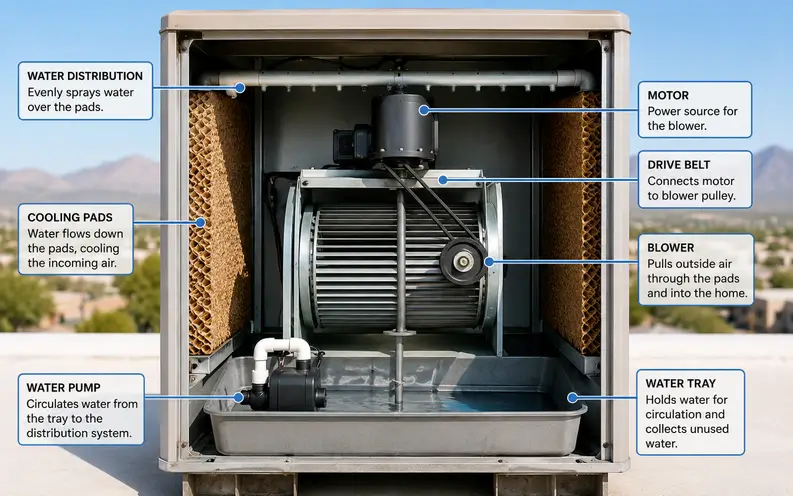
Start with the pads, because they’re the single most common reason a cooler stops cooling. Dry or mineral-caked pads can’t evaporate water, and without evaporation there’s no temperature drop. The U.S. Department of Energy’s Building America program says to replace torn, worn, or mildewed pads and to clean or swap the filter media as part of regular maintenance (DOE Building America). Pop the side panels and look: healthy pads should be evenly damp top to bottom while the unit runs.
See dry spots or a crust of white mineral buildup? That’s your problem. Albuquerque’s hard water is rough on swamp coolers — the high mineral content scales up pads and water lines faster than it would in a soft-water city. So the generic “replace your pads once a season” advice you’ll read online often isn’t enough here. Many ABQ homes need a mid-summer pad check, especially before the monsoon hits.
Aspen pads are cheap and should be swapped once or twice a season; rigid media pads last longer but still need rinsing. If your pads are brittle, slimy, or caked, replace them. It’s an inexpensive fix that solves a surprising number of “no cooling” calls. Not sure what your unit uses? Our professional swamp cooler service in Albuquerque can match and install the right pads.
Check 2 — Is the Water Level or Pump the Problem?
No water at the pads means no cooling, full stop. A healthy system keeps enough water in the tray for the pump to stay submerged so it can push a steady stream up to the pad frames. A float valve regulates that level, and because these are inexpensively made, they often need replacing every year or two. If the tray is low or bone dry, the cooler is just blowing air.
A swamp cooler’s float valve controls the water supply that keeps the pump submerged and feeds the pads. When the float sticks or breaks, the line clogs, or the pump fails, the pads dry out and the unit blows warm air even though the fan is running normally.
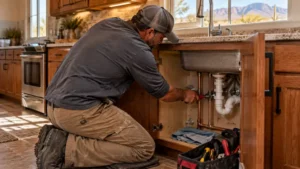
Three things to check here. First, the float valve — if it’s stuck closed, no water refills the tray; if it’s stuck open, you’ll get overflow. Second, the water line — minerals love to clog the small tubing that feeds the pads. Third, the pump itself. If the tray is full but the pads stay dry, the pump has likely failed and needs replacing.
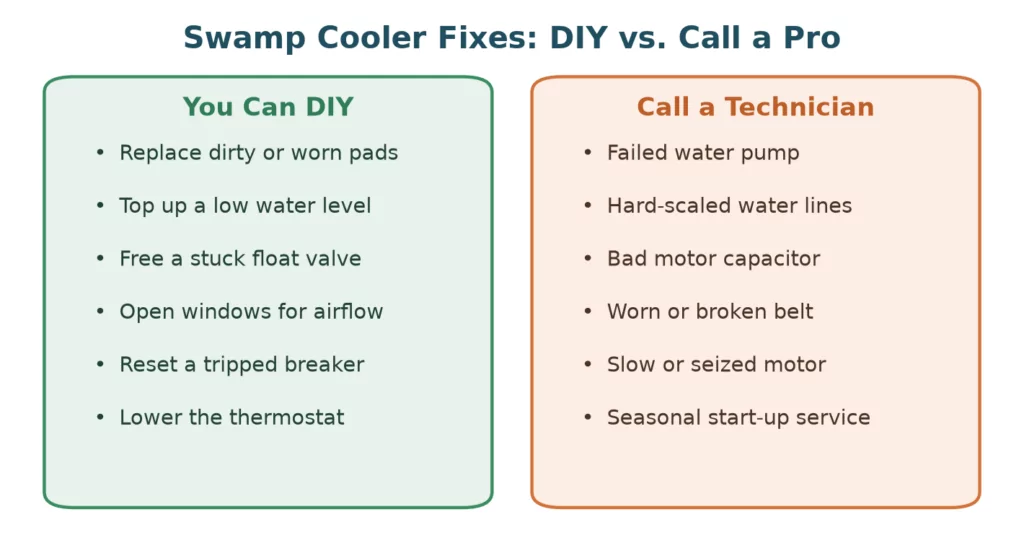
Topping the water and freeing a stuck float are DIY-friendly. A dead pump or a hard-scaled water line is where most homeowners decide to call us. The chart below shows where the line usually falls.
Source: Beyond Heating & Cooling field guidance, 2026.
Check 3 — Do You Have Enough Airflow? Open a Window
This one trips up almost everyone. A swamp cooler needs windows or doors cracked open to work. The U.S. Department of Energy’s Building America program is explicit: doors or windows must be opened to give the cool air a path to exit the house (DOE Building America). Without that escape path, the cool, moist air the cooler pushes in has nowhere to go, the house pressurizes, and cooling grinds to a halt. It feels backwards, but closing everything up — the instinct you’d follow with refrigerated AC — is exactly what kills a swamp cooler’s performance.
The fix is simple: open a window an inch or two in each room you want to cool, ideally on the shaded or downwind side of the house. You’re creating a one-way flow — fresh cooled air in, warm stale air out. As a rough rule, the more square footage your cooler serves, the more window you need open. If one room feels great and another feels stuffy, you probably need to crack a window in the stuffy room.
Why does this matter so much? Because a swamp cooler doesn’t recirculate air the way central AC does. It’s a constant stream of new air, and that stream has to keep moving. Block the exit and you’ve blocked the cooling.
Is Monsoon Humidity Killing Your Cooling?
If your cooler worked fine in June but quit in late July, the culprit probably isn’t your equipment — it’s the weather. In dry air an evaporative cooler can lower temperatures by 15 to 40°F, but it cools by adding moisture, so as the air gets muggy that temperature drop shrinks fast — the U.S. Department of Energy’s Building America program notes these coolers work best in dry climates, and that high humidity reduces performance (DOE Building America). No repair changes that, because it’s physics, not a fault.
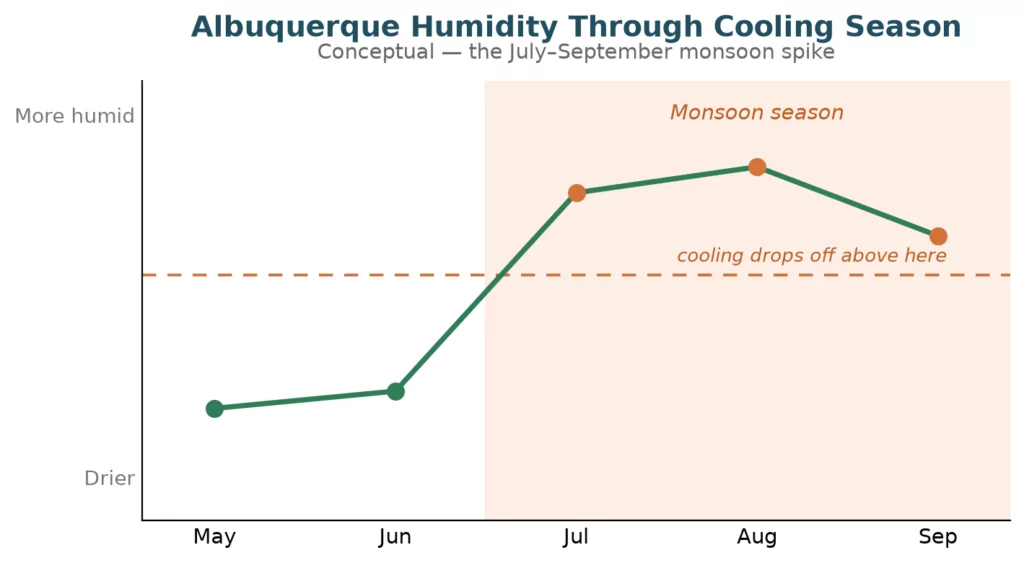
Here’s why. In late spring and early summer, Albuquerque air is bone-dry — often well under 30% relative humidity. The air is “thirsty,” water evaporates off the pads instantly, and you get a dramatic temperature drop. Then the monsoon arrives. New Mexico’s North American Monsoon runs from mid-June through September, pushing up humidity and dew points across the state (NWS Albuquerque). Once the air is already full of moisture, it simply can’t absorb much more from the pads — so the heat stays put.
In dry desert air, an evaporative cooler can drop temperatures by 15 to 40°F, but it works by adding humidity — so it performs best in dry climates and loses effectiveness as humidity climbs, per the U.S. Department of Energy’s Building America program (DOE Building America). During Albuquerque’s mid-June–September monsoon, rising humidity is the single most common reason a healthy swamp cooler suddenly “stops working.”
The chart below shows the relationship between humidity and how much cooling you can realistically expect.
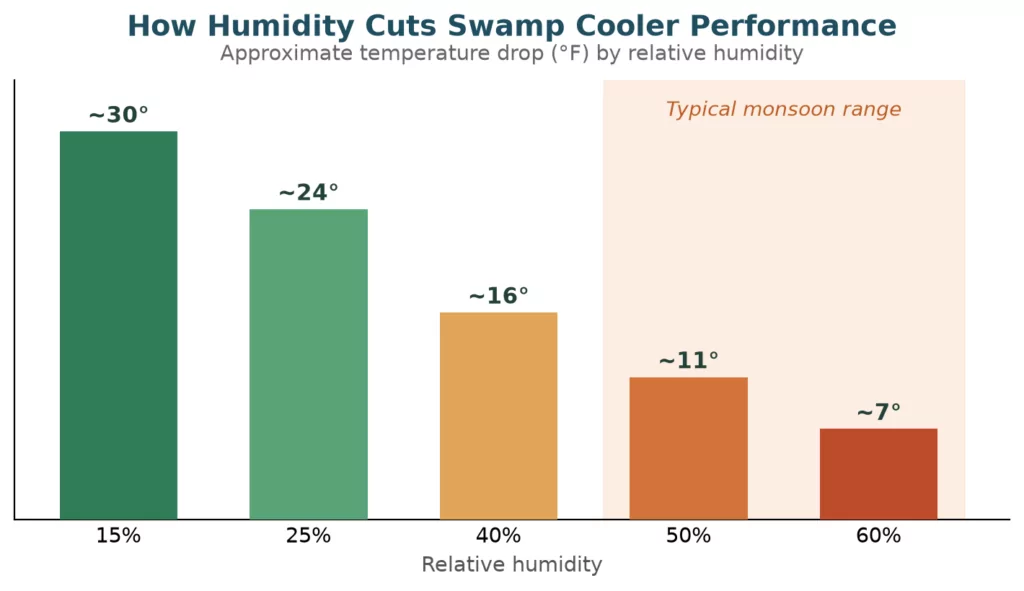
So what can you do during a humid stretch? Run the cooler in the early morning and evening when humidity dips, use the “up, down, and out” window approach to keep air moving, and accept that mid-afternoon on a soupy monsoon day, it just won’t feel as cold. If your home struggles every monsoon season, it may be worth weighing your options — our breakdown of swamp coolers vs. central AC in Albuquerque lays out the trade-offs.
Here’s the seasonal pattern that catches so many homeowners off guard — dry through late spring, then a sharp climb when the monsoon settles in:
What If the Cooler Won’t Turn On at All?
If the unit is completely dead or the fan barely moves, you’re looking at an electrical or mechanical fault rather than a cooling-efficiency issue. A blown fuse or tripped breaker is the first thing to rule out. In our techs’ experience, if the cooler hums but the fan won’t spin, a bad motor capacitor or a seized motor is the usual suspect.
Run through these quickly. Check your breaker panel and reset anything tripped. Look at the belt connecting the motor to the blower — a slipped or snapped belt is cheap to replace and a common cause of a spinning motor with no airflow. If you hear a low hum but nothing turns, don’t keep flipping the switch; that can burn out the motor. And don’t overlook the obvious: make sure the thermostat or control switch is actually set to “cool” and turned down far enough.
Capacitors, motors, and wiring aren’t DIY territory. There’s live electricity and moving parts involved, and a misdiagnosis gets expensive. That’s the point where a quick service call saves you money.
When to Call a Pro in Albuquerque
Here’s the simple rule: if the fix involves pads, water level, a stuck float, windows, or the thermostat, you can probably handle it yourself. If it involves the pump, motor, capacitor, belt, hard-scaled water lines, or a season-long humidity struggle, call a technician. There’s no prize for sweating through a monsoon week with a half-dead cooler.
Beyond Heating & Cooling offers same-day swamp cooler service across Albuquerque, Rio Rancho, Santa Fe, and Los Lunas. We’ll diagnose the real problem — not just swap parts — and tell you honestly when it’s the unit versus when it’s the weather. Call (505) 569-6939 or schedule service online and we’ll get your home comfortable again.
Frequently Asked Questions
Why is my swamp cooler blowing warm air?
Warm air from a running cooler almost always means the pads aren’t wet. Either they’re dry and clogged, the water level is too low, or the pump has failed and isn’t feeding water up to them. High outdoor humidity can also be the cause — as the air gets muggy, evaporative cooling drops off sharply, which is why the U.S. Department of Energy’s Building America program notes these coolers work best in dry climates (DOE Building America).
What humidity level is too high for a swamp cooler?
Swamp coolers work best in dry air and lose effectiveness as humidity rises — the U.S. Department of Energy’s Building America program notes they suit dry climates where humidity is low (DOE Building America). In Albuquerque, that’s mainly a concern during the mid-June–September monsoon, when humidity and dew points climb (NWS Albuquerque).
Should I open windows when running a swamp cooler?
Yes — and it’s essential, not optional. A swamp cooler pushes a constant stream of fresh, moist air into your home, and that air needs an exit. The U.S. Department of Energy’s Building America program is clear that doors or windows must be opened to give the cooled air a path out (DOE Building America). Without that escape path, the house pressurizes and cooling stalls.
How often should I replace swamp cooler pads in Albuquerque?
The U.S. Department of Energy’s Building America program advises replacing torn, worn, or mildewed cooler pads and cleaning or swapping the filter media each season (DOE Building America). In Albuquerque, plan on checking them more often: the area’s hard water scales up pads faster, so many local homes benefit from a mid-summer check before monsoon season.
Is my swamp cooler broken or is it just the monsoon?
Quick test: check your phone’s humidity reading. If it’s a dry day (well under 30%) and the cooler still won’t cool, you likely have a mechanical issue — dry pads, low water, or a failed pump. If the air is muggy, the unit is probably fine and the monsoon is the real cause. When in doubt, a technician can confirm in one visit.
The Bottom Line
A swamp cooler that runs but won’t cool isn’t always a repair job. Work through the checks in order — pads, water and pump, airflow, then humidity — and you’ll catch most problems before they cost you anything. Open those windows, keep the pads clean, and remember that Albuquerque’s monsoon will sap your cooling no matter how well your unit is running.
When the fix moves into pump, motor, or electrical territory, or when every humid afternoon feels miserable, that’s our cue. Call Beyond Heating & Cooling at (505) 569-6939 for same-day help, and bookmark our spring swamp cooler startup checklist so next season starts off cool.
Sources
- U.S. Department of Energy, Building America Solution Center (PNNL), “Evaporative Cooling Systems,” retrieved 2026-07-06, https://basc.pnnl.gov/resource-guides/evaporative-cooling-systems
- National Weather Service, Albuquerque, “North American Monsoon Statistics for New Mexico,” retrieved 2026-06-30, https://www.weather.gov/abq/northamericanmonsoon-statistics