Propane Furnace Installation in Albuquerque: What to Know Before You Hire
Propane furnace installation makes sense for Albuquerque-area homes with no natural gas line, which is common in Moriarty, Edgewood and Placitas. A proper job starts with a Manual J load calculation. It then covers the tank and gas line, venting, converting the furnace to propane, and a permitted inspection. Furnace size, efficiency, venting and gas piping set the price, so ask for an itemized written estimate.
Key Takeaways
- Size a propane furnace with a Manual J load calculation, not a square-foot rule of thumb.
- A natural gas furnace must be converted with the manufacturer’s propane kit before it runs on propane.
- Ask for an itemized written estimate that covers permits, venting, gas piping, conversion and the load calculation.
When does a propane furnace make sense for your home?
A propane furnace is worth it when your home has no natural gas service and you want forced-air gas heat. In rural parts of our area, including Moriarty, Edgewood and Placitas, a gas main often never reached the property. Propane is the practical way to run a gas furnace there.
It also fits when an existing propane furnace is wearing out. If you are unsure whether yours is done, our guide on when to replace a furnace can help. The ENERGY STAR guide to when it is time to replace also outlines the signs that point to replacing rather than repairing.
| Option | Fuel supply | What the install adds | Best fit |
|---|---|---|---|
| Propane furnace | On-site tank, filled by delivery | Tank, gas line, venting, propane conversion | Homes without a gas main that want gas heat |
| Natural gas furnace | Utility gas main | Gas line from the meter, venting | Homes already on a gas line |
| Heat pump | Electricity | Outdoor unit, line set, electrical circuit | Homes that want one system for heating and cooling |
How do you size a propane furnace to your house instead of using a rule of thumb?
Square footage alone cannot tell you what size propane furnace a house needs. The right size comes from an ACCA Manual J load calculation. It works out how much heat your home loses on a cold night based on insulation, windows, air leakage, orientation and ductwork.
Two houses of the same size can need different furnaces. A tight newer build in Rio Rancho loses heat at a different rate than a drafty older home in the East Mountains. After Manual J, the installer selects equipment under Manual S and checks the ducts under Manual D.
The Department of Energy’s guidance on purchasing energy-efficient residential furnaces explains that efficiency and correct sizing, not rule-of-thumb estimates, determine performance and operating cost. An oversized furnace short-cycles, burns more propane than it needs and leaves rooms uneven. An undersized one runs nonstop and falls behind on the coldest nights.
What does installation involve, from the tank and gas line to venting and inspection?
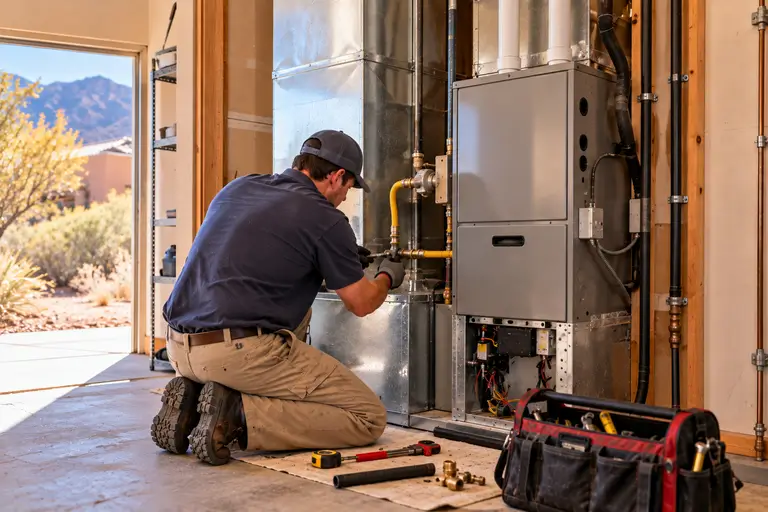
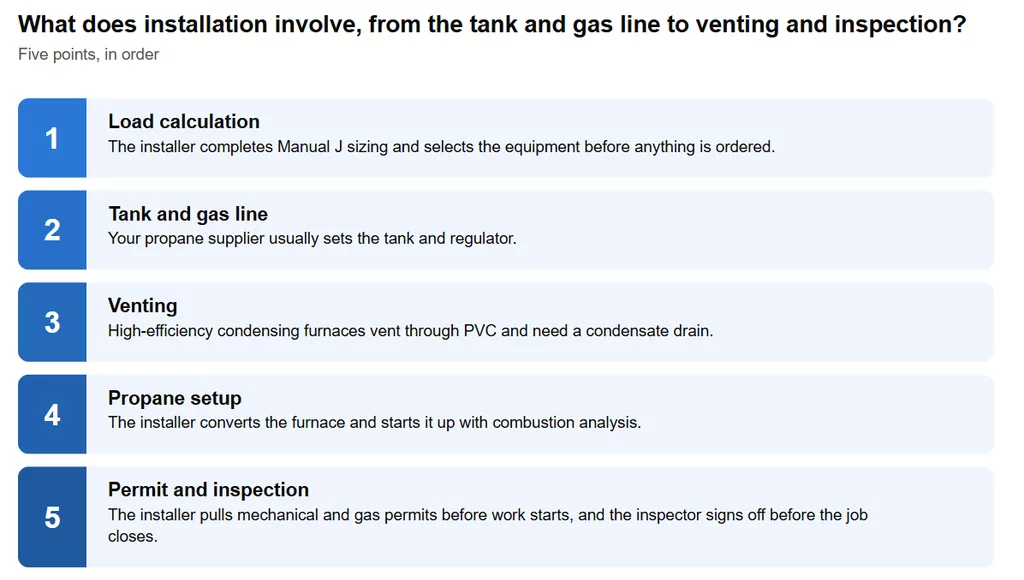
A propane furnace installation has five parts: sizing, the fuel supply, venting, propane setup and a permitted inspection. The DOE-funded Building America gas furnace replacement checklist covers the same ground, from proper sizing and venting to the gas line and inspection.
- Load calculation. The installer completes Manual J sizing and selects the equipment before anything is ordered.
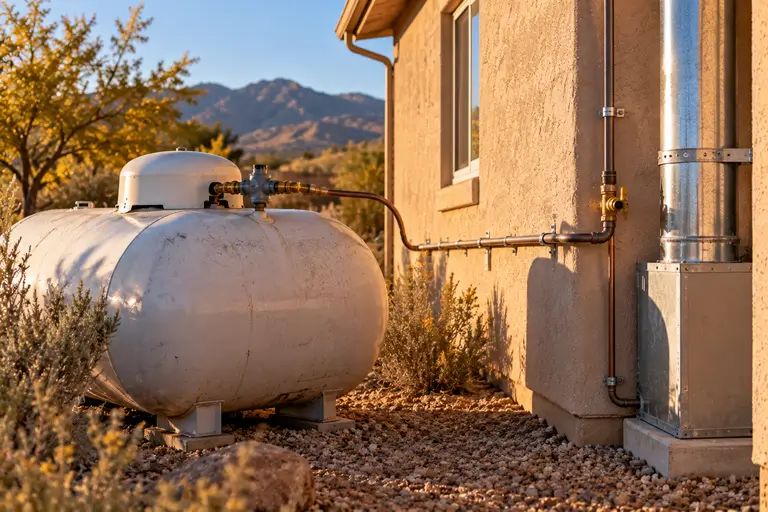
- Tank and gas line. Your propane supplier usually sets the tank and regulator. The gas line to the furnace is sized for the appliance and pressure tested before use.
- Venting. High-efficiency condensing furnaces vent through PVC and need a condensate drain. Standard-efficiency models use a metal flue.
- Propane setup. The installer converts the furnace and starts it up with combustion analysis.
- Permit and inspection. The installer pulls mechanical and gas permits before work starts, and the inspector signs off before the job closes.
Around Albuquerque, the inspecting authority depends on whether the home sits inside city limits or in the county. Your installer should know which code edition applies at your address.
Why does a natural gas furnace need converting to run on propane?
Propane and natural gas arrive at different pressures and burn at different air-to-fuel mixes. A furnace set up for natural gas will not burn propane safely as shipped. If it runs unconverted, it can overfire, build up soot and produce carbon monoxide.
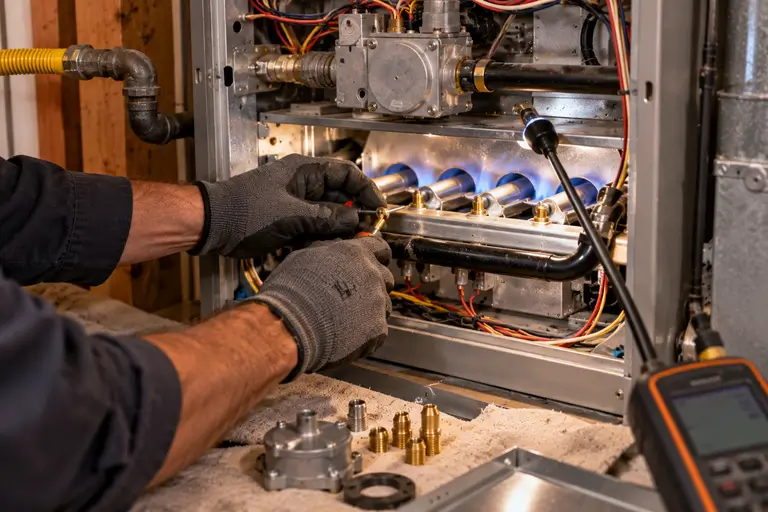
Most furnaces ship ready for natural gas. The installer converts them with the manufacturer’s approved propane kit, which changes the burner orifices and gas valve settings. Then the installer sets gas pressure to spec and runs combustion analysis to confirm a clean, steady flame. At the Albuquerque area’s elevation, the manufacturer’s high-altitude instructions apply as well.
AHRI’s homeowner explainer on how heating equipment works shows how the burner, heat exchanger and blower work together. Ask your installer to document the conversion and fix the conversion label to the furnace.
What drives the cost of a propane furnace install?
We don’t quote a flat price for propane furnace installation, because no two homes are set up the same way. What your job costs depends on what we find at your house, so we give you a real number after we’ve come out and inspected your home. Trane’s furnace product page notes that system costs vary with pricing factors homeowners should plan for.
What moves the price:
- Furnace capacity from the load calculation
- Efficiency tier, since condensing units add PVC venting and a condensate drain
- Length and routing of the gas line from the tank
- Venting changes, such as a switch from a metal flue to PVC
- Duct repairs or return air changes
- Electrical work, permits and the propane conversion kit
A like-for-like swap in a home already on propane usually involves less work than a first-time install that needs a new tank, gas line and venting. Financing is available. When you want a written number, start with our furnace installation service in Albuquerque.
How do you choose an installer, and what should you ask before you sign?
Choose a licensed HVAC contractor who sizes by load calculation, pulls the permits and converts the furnace to the manufacturer’s spec. The contractor should also put the full scope in a written, itemized estimate. Before you sign, ask:
- Will you run a Manual J load calculation, and can I see it?
- Who pulls the permits and schedules the inspection?
- Which conversion kit will you use, and will you do combustion analysis at startup?
- What does the estimate include and exclude, from venting to hauling away the old unit?
- What warranty covers the equipment and the labor?
Compare quotes line by line. A cheaper bid often leaves out the load calculation, the permit or the venting work.
Beyond Heating and Cooling has been family-operated since 2018 and holds license #410899. We serve Moriarty, Edgewood, Placitas, Albuquerque, Rio Rancho, Los Lunas, Los Ranchos and Santa Fe.You can book through our propane and gas furnace installation page or call (505) 382-1344. Our residential heating services cover the upkeep a new furnace needs after installation.
Frequently Asked Questions
What are the drawbacks of a propane furnace?
The main drawbacks are fuel logistics and price swings. You need a tank on site and scheduled deliveries, and you have to watch the gauge. Propane prices can move with the season. If the tank runs dry, the system needs a leak check and relight before the furnace runs again.
What’s the average lifespan of a propane furnace?
Lifespan depends more on sizing, installation quality and yearly service than on the fuel itself. A correctly sized, well-vented furnace with annual maintenance lasts longest. AHRI’s maintenance tips for homeowners cover the basics, and a fall furnace tune-up catches worn parts early.
Is it cheaper to heat with electricity or propane?
It depends on local propane prices, your electric rate and the efficiency of the equipment. A heat pump is the main electric option to price against propane, and a dual-fuel setup pairs a heat pump with a gas furnace. Our guide to the benefits of heat pump installation explains the trade-offs.
Sources
- Gas Furnace Replacement | Building America Solution Center – basc.pnnl.gov, retrieved 2026-09-25
- Purchasing Energy-Efficient Residential Furnaces | Department of Energy – energy.gov, retrieved 2026-09-25
- When is it time to replace? | ENERGY STAR – energystar.gov, retrieved 2026-09-25
- How Things Work | AHRI – ahrinet.org, retrieved 2026-09-25
- AHRI Offers HVACR and Water Heating Maintenance Tips for Homeowners | AHRI – ahrinet.org, retrieved 2026-09-25
- Furnaces – High Efficiency Furnaces – Trane® – Trane, retrieved 2026-09-25