A smart thermostat promises lower bills, app control from your phone, and a house that cools itself before you even walk in. For a lot of Albuquerque homes, it delivers. But there’s a local catch nobody mentions in those glossy product reviews: if you run a swamp cooler, the popular models may not work with your system at all.
So are they worth it here? Short answer: yes for most central-AC homes, with a real asterisk for evaporative coolers. Let’s break down the honest, equipment-by-equipment verdict.
Key Takeaways
- ENERGY STAR–certified smart thermostats save about 8% on heating and cooling — roughly $50 a year — and can save more in climates with big temperature swings like Albuquerque’s (ENERGY STAR, 2026).
- The local catch: most smart thermostats run on 24 volts and can’t directly control a 120/240-volt swamp cooler without a relay adapter or an evaporative-specific controller.
- Best payoff: homes with central/refrigerated AC and a furnace or heat pump.
- Switching from a swamp cooler to refrigerated air? That’s the ideal moment to add one.
Are Smart Thermostats Worth It? The Short Answer
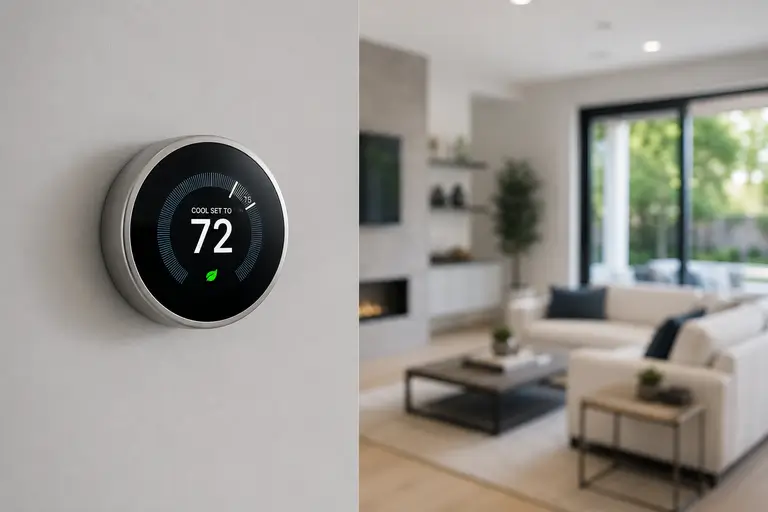
For most Albuquerque homes with central air conditioning, yes. As of 2026, ENERGY STAR reports that certified smart thermostats save the average household about 8% on heating and cooling costs, or roughly $50 per year (ENERGY STAR, 2026). Over a thermostat’s lifespan, that adds up well past its purchase price.
But “worth it” depends on what’s behind your wall. A home with central AC and a furnace or heat pump is the sweet spot — the thermostat controls everything, and scheduling plus remote adjustment do the rest. A home running a swamp cooler is a different story, and we’ll get to why. The verdict isn’t one-size-fits-all, and any honest answer has to start with your equipment.
How Much Can You Actually Save in Albuquerque?
The headline number is about 8%, but Albuquerque’s climate can push it higher. ENERGY STAR notes that savings “may be greater depending on climate, personal comfort preferences, occupancy, and/or heating/cooling equipment” (ENERGY STAR, 2026). Our high desert checks two of those boxes hard: a long cooling season and a big daily temperature swing.
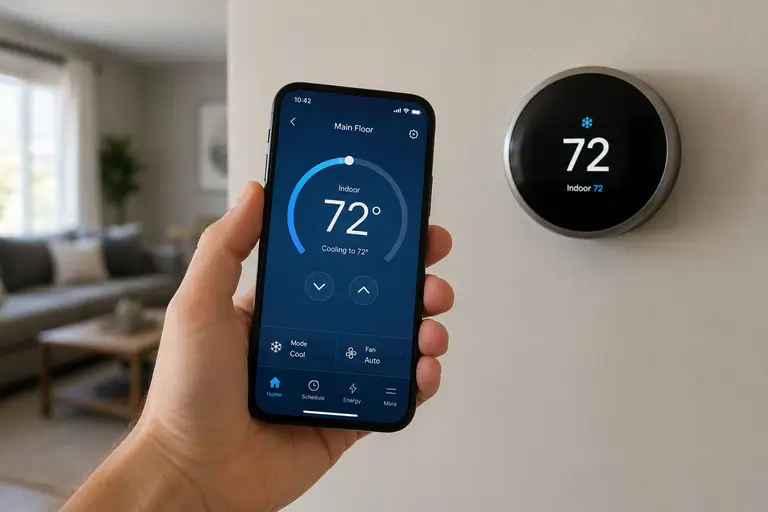
Here’s the local play. Albuquerque summers routinely drop 25 to 30 degrees between a 98°F afternoon and a cool overnight. A smart thermostat lets you lean into that — pre-cool the house in the cheaper, cooler morning hours, then ease off during the peak-heat afternoon. Geofencing shuts things down when the house is empty and spins them back up before you’re home. Manual thermostats can’t react to any of that.
As of 2026, ENERGY STAR verifies smart-thermostat savings using real-world data from a large sample of homes, and reports average savings of about 8% on heating and cooling — around $50 per year — with greater savings possible in favorable climates (ENERGY STAR, 2026). Albuquerque’s long cooling season and wide day-night temperature swing make it a strong candidate for the higher end.
And don’t overlook rebates. Many utilities and energy-efficiency programs offer incentives on ENERGY STAR–certified smart thermostats that can offset a big chunk of the purchase price. Before you buy, it’s worth checking ENERGY STAR’s rebate finder or asking your local provider what’s available (ENERGY STAR, 2026).
Want the schedule dialed in right? A professional thermostat and AC tune-up is the fastest way to make sure the settings actually match how your system runs.
Do Smart Thermostats Work With Swamp Coolers?
Usually not directly — and this is the single most important thing for Albuquerque homeowners to understand. Most smart thermostats (Nest, Ecobee, and similar) are built for low-voltage 24V HVAC systems. A traditional swamp cooler runs on 120 or 240 volts and switches a fan motor, a water pump, and sometimes a purge pump. Those are two very different electrical worlds, and you can’t just wire one to the other.
So what are your options? There are two realistic paths. First, a relay adapter can sit between a standard smart thermostat and the cooler, letting the low-voltage thermostat switch the higher-voltage circuits safely. Second, you can use a controller designed specifically for evaporative coolers, which handles fan speeds and the pump directly. Both work, but each adds cost and complexity — which is exactly why a quick assessment beats guessing.
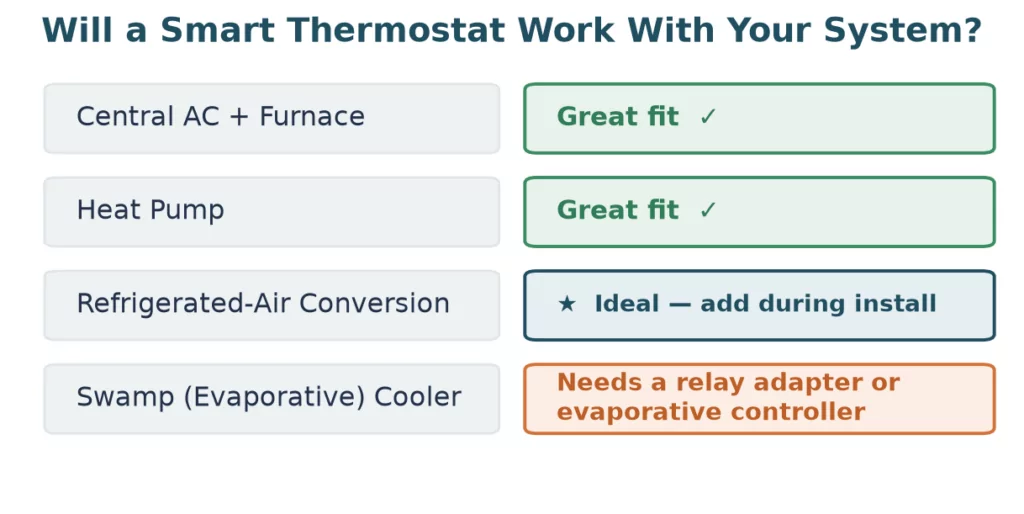
Most smart thermostats operate on 24 volts, while a traditional swamp cooler runs on 120 or 240 volts and drives a fan motor and water pump. Because of that voltage mismatch, popular smart thermostats can’t control an evaporative cooler directly; it takes a relay adapter or an evaporative-specific controller to bridge the gap.
The chart below shows which systems are a clean fit and which need extra hardware.
Source: Beyond Heating & Cooling field guidance, 2026.
If you’re weighing whether to stick with evaporative cooling or move to central air, our guide to swamp coolers vs. refrigerated air in Albuquerque walks through the trade-offs — and a swamp cooler service visit can tell you exactly what your current setup will and won’t support.
Which Homes Get the Most Value?
Homes with central, refrigerated AC and a furnace or heat pump see the fastest payback. Because a smart thermostat controls the whole system on standard 24V wiring, every feature works as intended — scheduling, geofencing, remote control, and usage reports all pull in the same direction to trim runtime.
A few situations make the value even clearer. If your household is often away on an unpredictable schedule, geofencing stops you from cooling an empty house. If you work from home, pre-cooling before the afternoon peak keeps you comfortable for less. And if you’re already planning a refrigerated-air conversion, add the thermostat during that project — the wiring is open, the tech is on-site, and you skip a second service call. Timing it that way is the cheapest a smart thermostat will ever be to install.
Two other groups benefit more than they expect. Larger or two-story Albuquerque homes with uneven temperatures gain a lot from precise scheduling, since the upstairs and downstairs rarely need cooling at the same time. And if you own your home long-term, the savings compound — a thermostat that trims about 8% every cooling season pays for itself and then keeps paying. Renters get less out of it, so a simple, easy-to-remove model usually makes more sense there.
Smart vs. Programmable vs. Manual: What’s the Real Difference?
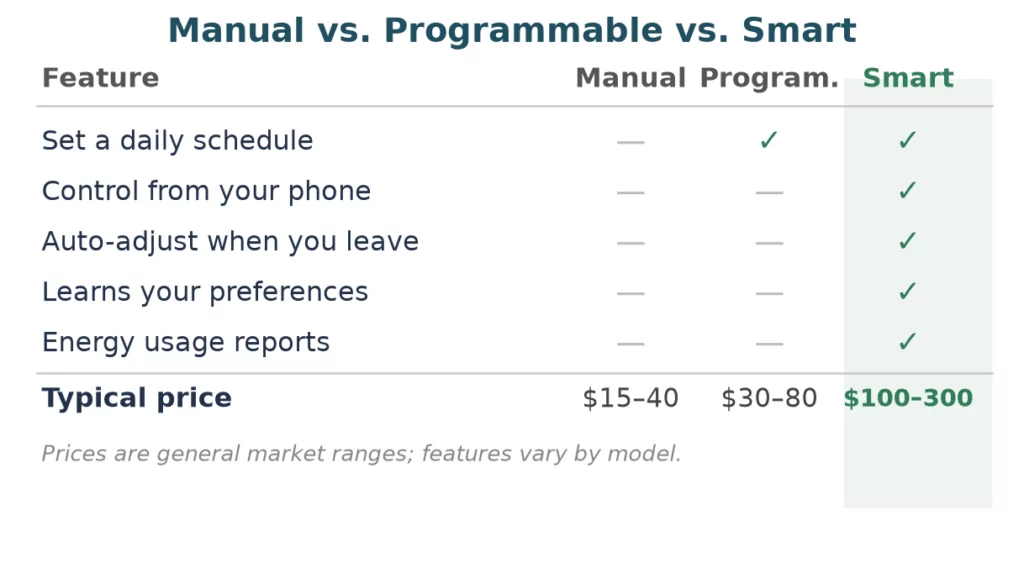
The jump from manual to smart is really two jumps. A programmable thermostat lets you set a schedule, which already beats a manual dial you forget to touch. A smart thermostat adds the internet: phone control, automatic adjustments when you leave, learning your patterns, and reports that show where your energy goes. That’s where the ENERGY STAR savings and the day-to-day convenience come from.
Is the smart premium worth it over a basic programmable model? In Albuquerque, usually yes — the geofencing and remote control earn their keep across a long cooling season. But if you keep a rock-solid manual schedule and don’t want an app, a quality programmable thermostat captures much of the benefit for less. Here’s how the three stack up.
Source: Beyond Heating & Cooling, 2026. Feature availability varies by model.
Installation: DIY or Call a Pro?
For a standard central system with a C-wire, a smart thermostat is a doable weekend project. The catch is that “standard” and “has a C-wire” aren’t a given in Albuquerque’s older housing stock. The C-wire (common wire) supplies steady power to the thermostat, and plenty of local homes don’t have one — which turns a quick swap into a wiring job.
Call a pro when any of these apply: there’s no C-wire, you have a swamp cooler, you run a multi-stage or heat-pump system, or you’re mid-conversion to refrigerated air. Those are the cases where a wrong connection either won’t work or can damage equipment. When you want it done once and done right, schedule a thermostat assessment or call us at (505) 569-6939 — we’ll confirm compatibility, handle the wiring, and set up the schedule for your home.
The Verdict for Albuquerque Homeowners
Here’s the bottom line by equipment. If you have central or refrigerated AC with a furnace or heat pump, a smart thermostat is worth it — the roughly 8% savings, the geofencing, and the pre-cooling all fit our climate. If you’re converting from a swamp cooler to refrigerated air, add one during the project; it’s the ideal moment. If you run a traditional swamp cooler and want to keep it, a smart thermostat is possible but needs an adapter or a specialized controller, so weigh the cost against a simpler evaporative thermostat. And if you’ll never open the app? A solid programmable model may be all you need.
Frequently Asked Questions
Do smart thermostats really save money?
Yes, modestly and reliably. ENERGY STAR–certified smart thermostats save about 8% on heating and cooling costs — roughly $50 per year for the average home — verified using real-world data from many homes (ENERGY STAR, 2026). Savings can be higher in climates with a long cooling season and big temperature swings, like Albuquerque’s.
Do smart thermostats work with swamp coolers?
Not directly, in most cases. Most smart thermostats run on 24 volts, while a traditional swamp cooler runs on 120 or 240 volts to drive its fan and pump. Bridging that gap takes a relay adapter or a controller built specifically for evaporative coolers. A quick assessment tells you which route fits your setup.
What’s the best smart thermostat for Albuquerque?
The best one is the one that matches your equipment. For central AC with a C-wire, mainstream models like Nest or Ecobee work well. For a swamp cooler, you’ll need an evaporative-specific controller or an adapter. Because compatibility matters more than brand here, confirm your wiring and system type before buying.
Do I need a C-wire for a smart thermostat?
Usually, yes. Most smart thermostats need a C-wire for steady power, and many older Albuquerque homes don’t have one. Some models include a power adapter or add-on kit to work around it, but the cleanest fix is running a proper C-wire — a common reason homeowners call a pro for the install.
Can a smart thermostat run both my heater and AC?
Yes. On a standard central system, one smart thermostat controls both heating and cooling and switches between them automatically. That’s exactly the setup where these thermostats shine, and where the ENERGY STAR savings apply across the whole year, not just summer.
The Bottom Line
For most Albuquerque homes with central AC and a heat source, a smart thermostat is worth it — you get real savings, remote control, and a system that works around our big temperature swings. The one group that needs to look before leaping is swamp cooler owners, thanks to that 24V-versus-120/240V mismatch. Know your equipment, and the decision gets easy.
Not sure what your home can support? Call Beyond Heating & Cooling at (505) 569-6939 for a straight answer, and ask about our HVAC maintenance plans to keep the whole system running efficiently — thermostat and all.
Sources
- ENERGY STAR, “Smart Thermostats,” retrieved 2026-07-06, https://www.energystar.gov/products/smart_thermostats
- ENERGY STAR, “Smart Thermostat FAQs for EEPS,” retrieved 2026-07-06, https://www.energystar.gov/products/heating_cooling/smart_thermostats/smart_thermostat_faq
- ENERGY STAR, “Rebate Finder,” retrieved 2026-07-06, https://www.energystar.gov/rebate-finder