Nationally, a plumber’s hourly rate typically runs $45 to $200, according to HomeAdvisor’s plumber cost guide, and a commercial bill in Albuquerque is built up from labor hours like those. If you pay for plumbing on a business property, this page explains how those bills are put together and how to get a price you can hold a plumber to.
Key Takeaways
- Expect a commercial price to reflect the whole building’s piping, so a quote made without seeing the system is only a guess.
- Settle off-hours pricing on the phone before the truck rolls, so a night emergency does not end in a surprise invoice.
- Insist on a site visit and a written description of the work before you accept any number, because a vague scope lets the price drift.
- Match the billing method to the job: open-ended repairs suit time-based billing, while a well-defined task suits one fixed price.
Why is a commercial plumbing job priced differently from a home repair?
A commercial job is priced on a building’s whole system, not one fixture, so the scope is harder to pin down before work starts. A business has longer drain runs and more fixtures tied to one line. Its customers or tenants also need the water back on, so the work is often timed around opening hours. With that uncertainty, a pricing guide for plumbing business owners on plumbermag.com notes that some plumbing businesses bill projects on time and materials (the hours worked plus the parts used) because it helps keep each job profitable. That building-scale work is what our commercial plumbing service covers. A failure that cannot wait goes to emergency plumbing, and the cost of emergency repairs in Albuquerque is broken down on its own.
How do after-hours and emergency calls change the bill?
An after-hours call costs more than the same repair in daytime hours; how much more depends on how the plumber prices nights and weekends. Before anyone heads out, ask how the off-hours rate is figured and whether a trip charge or minimum applies. Ask too when billing starts: at dispatch or on arrival. If the water can be shut off and the work can wait until morning, the daytime rate may apply. Deciding whether a problem needs an emergency plumbing call is the first step in controlling that bill.
How do you get your building’s plumbing work scoped and priced?
Have the plumber see the building in person, then get the scope in writing before any price is attached. A commercial price holds only as well as the work description behind it.
- Gather what you know first: which fixtures or lines are failing, when it started, where the main shutoff sits, and any building drawings.
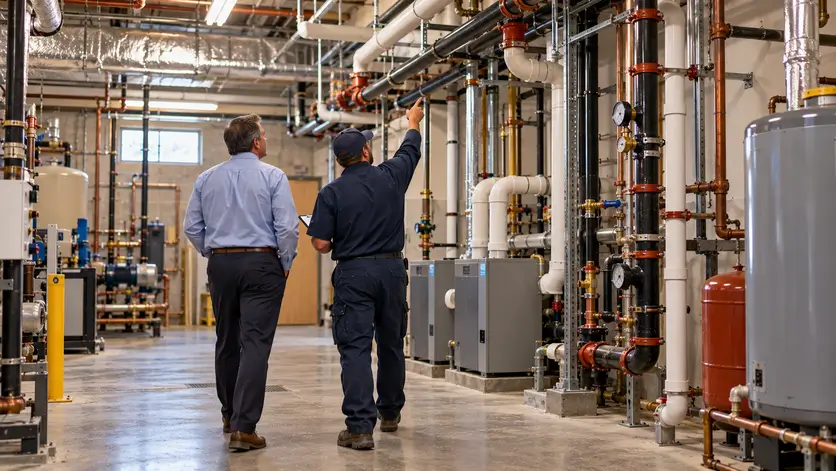
- Walk the plumber through the space, including the mechanical room and any area that has to stay open during the work.
- Ask for a written scope that names each task and states what is left out.
A tenant build-out or new building is priced from the plans as a project, which is how new construction plumbing is bid.
Do commercial plumbers bill hourly, flat-rate or by contract?
Commercial plumbers use all three methods, and the kind of job usually decides which one shows up on your bill. Hourly work pays for more than the time a plumber spends at the pipe: HomeAdvisor’s plumber cost guide says the hourly rate covers the plumber’s salary, insurance premiums, overhead, equipment and tools. For scale, HomeAdvisor’s June 2026 data, as reported by homerepairdispatch.com, puts commercial plumbers at an average of $100 an hour against $80 for residential work.
| Billing method | How the price is set | Where it fits | What to pin down first |
|---|---|---|---|
| Hourly (time and materials) | Hours on site plus the parts used | Repairs where the cause stays hidden until a line is opened | How time is logged and how parts are charged |
| Flat rate | One price for a named task, quoted before work starts | A defined job, such as replacing a valve or a fixture | What happens if the job grows past the quoted task |
| Contract | A written price tied to an agreed scope | Build-outs priced from plans, or recurring work on a set schedule | Which tasks are included and how changes are priced |
What drives the cost of a commercial plumbing job?
Nationally, the typical figures come from guides that price different jobs. HomeAdvisor’s plumber cost guide puts professional plumber services at $182 to $501 ($341 on average) and a plumbing inspection at $100 to $500, without saying whether commercial work is included. For a business, homerepairdispatch.com’s commercial plumbing guide cites HomeGuide for backflow testing at $30 to $300 per device, so the number of devices on your water service sets that line.
The rest of the cost sits in the work itself. The Bureau of Labor Statistics’ profile of plumbers lists reading blueprints and following state and local building codes among the trade’s tasks, along with working out the materials and equipment a job needs. In a commercial building, these move that work:
- Length and size of the lines. Longer runs and larger pipe take more material and more hours.
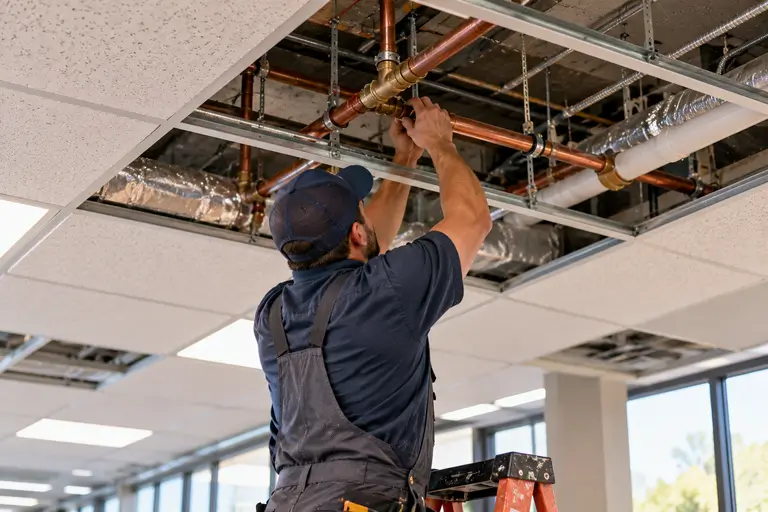
- Access. Pipe behind finished walls, above a ceiling grid or under a slab has to be opened up and closed again.
- Testing. Inspecting and testing installed pipe is part of the job and adds time.
- Prepare cost estimates for clients
- Read blueprints and follow state and local building codes
- Troubleshoot malfunctioning systems
- Maintain and repair plumbing sysems
Planned maintenance versus paying when something breaks
Which costs less depends on your building, not on a rule. Planned maintenance means paying for scheduled visits that look for wear before it fails. Paying on breakdown means you spend nothing until a line or fixture quits, then pay for the repair plus whatever the outage costs you. The deciding questions are what a failure would shut down and how old your plumbing is. Ask any plumber quoting a maintenance plan which tasks each visit covers and what you would still pay for separately.
How do you compare quotes from commercial plumbers?
Compare quotes against the same written scope, line by line, rather than by the total at the bottom. Two prices for different work tell you nothing about which plumber costs less.
Lay the quotes side by side and check that each covers the same fixtures and lines. If one includes testing the new pipe or patching the wall it opened and another leaves those out, the lower number may only reflect a shorter list. Check the billing method too. You cannot weigh an hourly estimate against a flat price until you know how many hours the first one assumes.
Ask each plumber which license number they work under and whether they carry insurance.
We are licensed and insured, under license #410899. If you want a quote from us to set beside the others for a building in Albuquerque or nearby, send us your plans and request a written, itemized scope, or call (505) 382-1344.
Sources
- Plumbers, Pipefitters, and Steamfitters : Occupational Outlook Handbook, U.S. Bureau of Labor Statistics, Occupational Outlook Handbook, retrieved 2026-10-15.
- How Much Does It Cost to Hire a Plumber? (2025 Data), HomeAdvisor (cost guide), retrieved 2026-10-15.
- Plumbing Flat Rate Pricing Guide: Price Book Tips to… | Plumber, plumbermag.com, retrieved 2026-10-15.
- Commercial Plumbing: $100 an Hour, Backflow and Grease Traps, homerepairdispatch.com, retrieved 2026-10-15.