It’s late May. Albuquerque’s first 90°F days are either here or a week out, and your swamp cooler has been sitting under a cover since October. Now is the time to get it running — not next week, and definitely not the morning of the first serious heat wave.
The startup process itself isn’t complicated. What trips up most ABQ homeowners are the two or three steps that matter specifically here: hard water that scales your pads every single winter, an elevation that quietly stresses your belt, and a float valve that causes a mess if you skip it. This 7-step checklist covers all of it — including the first-run procedure most guides leave out entirely.
Key Takeaways
- Albuquerque’s municipal water averages 153 PPM (~12 GPG) — in hard water, annual pad replacement is standard, not the generic “every 2–3 years” guidance
- The ideal startup window is the first two weeks of May, before the first 90°F day
- At 5,312 ft elevation, belt condition is more critical here than at sea level — replace any marginal belt now
- Skipping the float valve check is the leading cause of pan flooding on startup day
When Should You Start Your Swamp Cooler in Albuquerque?
According to the NOAA National Weather Service Albuquerque office, the average last freeze in Albuquerque falls in mid-March, and daily highs reach the upper 80s by late May. The practical startup window is the first two weeks of May — early enough for a real test run, late enough that freeze risk is off the table.
Starting too late is the more common mistake. Nobody wants to discover a seized belt or a stuck float valve at 4 p.m. on a 97°F day when the hardware store is a 40-minute round trip and you have dinner company coming. A May startup gives you time to find problems at a calm moment.
There’s also a season endpoint to keep in mind. Once Albuquerque’s monsoon arrives — typically the second week of July — humidity climbs from the usual 5–15% to 25–40%, and evaporative cooling loses effectiveness for roughly 6–8 weeks. You get a solid window from May through early July. For a full look at how the monsoon changes the math on cooling options, including costs and a hybrid approach, see our swamp cooler vs. central AC comparison for Albuquerque homeowners.
What You’ll Need Before You Climb Up There
Gather everything before you start. Nothing interrupts a startup job quite like a mid-step hardware run.
Materials checklist:
- New evaporative cooler pads (measure your unit — dimensions vary)
- A replacement V-belt (same profile and length as your current belt — have one on hand)
- Adjustable wrench and flat-head screwdriver
- Garden hose with a spray nozzle
- White vinegar or evaporative cooler descaler
- Light machine oil, if your motor has oil ports (many newer motors are sealed)
On pad replacement frequency: Most guides say every 2–3 years. That guidance was written for soft-water regions, where water hardness runs below 7 GPG. Albuquerque’s municipal water averages roughly 12 GPG. One season is enough for mineral scale to accumulate inside pad media and choke airflow — even when the pads look intact on the surface. Plan on annual replacement. Our swamp cooler pad replacement guide for Albuquerque covers sizing, aspen vs. synthetic, and step-by-step installation if you want the full walkthrough.
The 7-Step Swamp Cooler Startup Checklist for Albuquerque
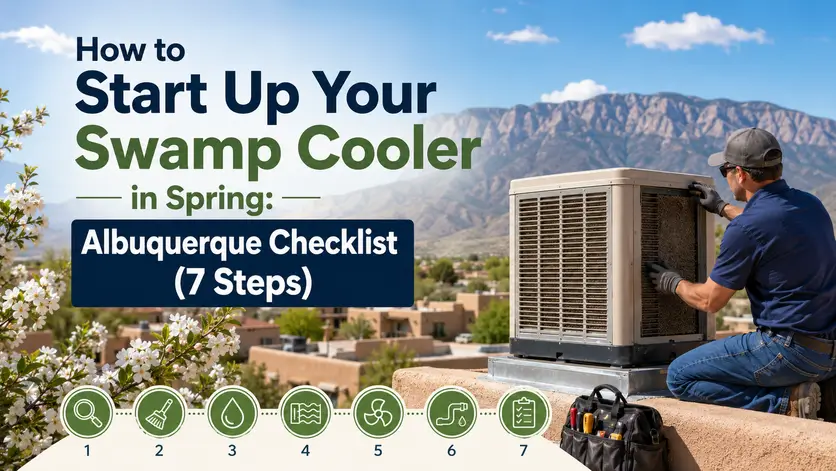
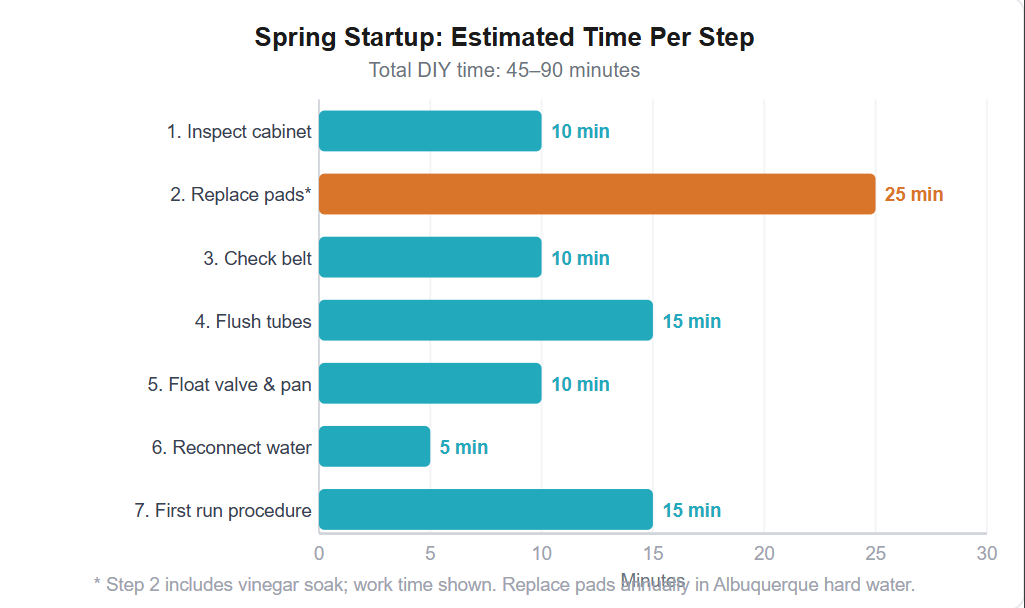
A full DIY startup — done right — takes most Albuquerque homeowners 45 to 90 minutes. Step 2 (pad replacement) is the one that makes the biggest difference in a hard-water market; the rest are standard mechanical checks that take 5 to 15 minutes each. Work through them in order, and you’ll catch any problems before you’re running the unit at full load.
Step 1: Remove the Cover and Inspect the Cabinet
Pull off the winter cover and look the unit over before touching anything else. Check for rust spots, cracked panels, and signs of animal nesting — birds and rodents find evaporative cooler cabinets very welcoming over winter. In Albuquerque, you’ll often find a film of alkali dust on the exterior. Wipe that down before you open the unit up so it doesn’t work its way inside.
Ten minutes of inspection now can tell you whether you’re looking at a routine maintenance job or something that needs a second look before startup.
Step 2: Replace the Evaporative Pads
This is the most important step in any hard-water market, and Albuquerque is one of them.
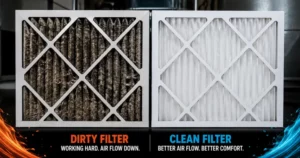
According to the City of Albuquerque’s 2024 Water Quality Report, our municipal water averages 153 PPM of total dissolved solids — approximately 12 grains per gallon. At that hardness level, calcium and magnesium carbonates accumulate inside pad media over a single season, blocking the channels that allow air to flow through and pick up moisture. Mineral-scaled pads don’t always look visibly clogged, but they restrict airflow enough to reduce cooling output and put extra load on the motor.
What we see in the field: Of the startup calls we respond to each spring, the majority involve units where pads weren’t replaced — and in many cases the homeowner says the pads looked fine. Mineral scaling happens on the inside. A pad that looks okay on the surface can be significantly underperforming.
Pull the old pads, rinse any loose scale from the pad frame, and install fresh ones. If you’re unsure about sizing or pad type, the swamp cooler pad replacement guide walks through everything.
Step 3: Check and Adjust the Belt
Open the access panel and find the V-belt connecting the motor to the blower shaft. Press down on it midway between the pulleys — you should feel about ½ to ¾ inch of deflection. Too loose means slipping; too tight strains the motor bearings.
Look for visible wear: cracks along the sides, a glazed or shiny surface, fraying. Any of those is a replace-now situation.
Here’s the Albuquerque factor most guides don’t mention: at 5,312 feet above sea level, air density is roughly 17% lower than at sea level. The blower has to move a larger volume of air to deliver equivalent cooling, which puts slightly more load on the motor and belt than it would at lower elevations. A belt that might survive another summer in Phoenix has a higher chance of failing here. They cost $10–$15 and take about 15 minutes to swap. If there’s any doubt, replace it now.
Step 4: Flush the Water Distribution Tubes
The small tubes that run water across the top of the pads often plug with mineral deposits over winter. Remove them and soak in white vinegar for 20–30 minutes to dissolve carbonate buildup — then rinse thoroughly. You don’t want vinegar residue running through the unit on first startup.
While you have them out, check each orifice for blockages. A toothpick or fine wire can clear most of them. If the tubes are cracked or badly scaled, they’re an inexpensive replacement.
Step 5: Inspect the Float Valve and Drip Pan
The float valve controls water level in the drip pan. When it’s working correctly, it fills the pan to the right level and shuts off. When it isn’t — whether because the float is stuck, corroded, or the valve seat is worn — the pan overflows and water runs down the side of the house.
Set the float so the waterline sits about ¾ inch below the top of the pan overflow tube. While you’re in there, check the pan itself for significant rust scale or holes. Light surface rust is normal; actual holes or deep pitting means the pan needs treatment or replacement this season.
Step 6: Reconnect the Water Supply Line and Check for Leaks
Reconnect the supply line fitting, turn the water on slowly, and watch every connection point for drips. Run water through the system for five full minutes before you start the blower. This fills the pan, saturates the pads, confirms the float valve is working, and lets you catch any leaks now — at a low-stakes moment.
Step 7: The First Run Procedure
Start in ventilate-only mode — blower on, pump off — for 10 to 15 minutes. This clears out the winter dust and debris from the cabinet and ductwork before wet air pushes it into your living space. Then switch to cool mode.
Normal on first run:
A musty or dusty smell for the first 15–30 minutes is completely expected. It’s the dust that settled on the pads and cabinet over winter. It clears on its own.
Not normal — shut down:
- Burning rubber smell — belt is slipping or over-tensioned; stop and recheck belt tension
- Sharp electrical smell — motor problem; shut down immediately and call a technician
- Grinding or rattling — dry bearings or something loose in the blower cage; investigate before running further
If everything sounds and smells right after the first 20 minutes of cool mode, you’re done. Run it for an hour before you leave the house to confirm everything holds steady.
When to Call a Pro vs. Handle It Yourself
Professional swamp cooler startup services in the Albuquerque market typically run $89–$129, based on local HVAC service call data (Angi, 2025). For most homeowners, that cost makes sense when the unit is older or multiple issues show up at once. For a healthy unit, the tasks below fall solidly within DIY territory. Here’s where the line is:
| Situation | DIY? | Notes |
| Pad replacement | Yes | 20–30 min |
| Belt check and adjustment | Yes | 5 min |
| Belt replacement | Usually yes | $10–$15 part, ~15 min |
| Distribution tube flush | Yes | Vinegar + rinse |
| Float valve adjustment | Yes | Simple |
| Float valve replacement | Usually yes | Inexpensive part |
| Motor won’t start | Call a pro | Capacitor, wiring, or motor failure |
| Water valve won’t shut off | Call a pro | Usually needs replacing |
| Burning smell that doesn’t stop | Call a pro | Don’t run the unit |
| Belt + pulley damaged | Call a pro | Needs shaft alignment |
| Unit 10+ years old, multiple issues | Consider a pro | Full inspection may be worthwhile |
If something’s clearly off — a motor that won’t start, a burning smell that doesn’t go away, a water leak you can’t locate — don’t run the unit. Call Beyond Heating and Cooling at 505-569-6939. We’re available 24/7. You can also schedule a swamp cooler service visit online.
A professional startup and inspection typically runs in the $89–$129 range in the Albuquerque market. Call us for current pricing.
ABQ Swamp Cooler Season: Timing and What Comes Next
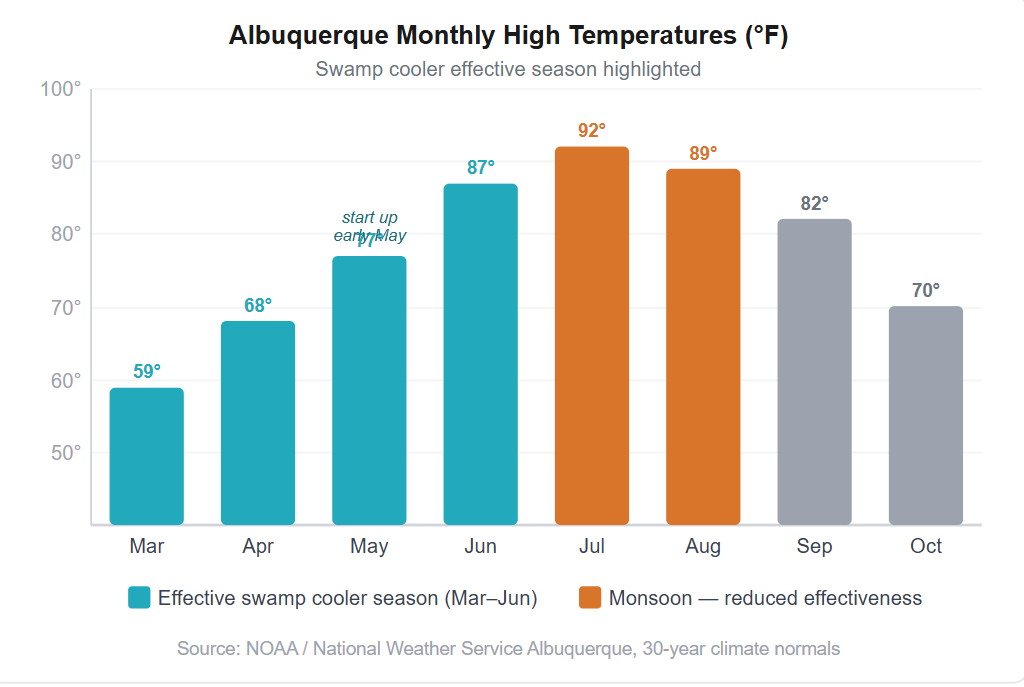
In 2021, the U.S. Department of Energy’s Energy Efficiency & Renewable Energy guide reported that evaporative coolers use up to 75% less electricity than central air conditioning. That advantage is real in Albuquerque — but it’s seasonal. The effective window runs from roughly March through early July, when humidity stays in single digits to the low 20s. Once the monsoon pushes humidity into the 25–40% range, usually around the second week of July, an evaporative cooler simply can’t keep pace.
Knowing the season shape changes how you think about maintenance. Get the unit running clean in early May. Check the pads mid-June — especially if we get an early humidity spike. Be ready to adapt when the monsoon arrives. We’ll have a dedicated guide for managing that stretch later this summer.
For a bigger-picture look at swamp coolers in Albuquerque — including a full cost comparison with central AC, how long they last in our climate, and when the hybrid mini-split option makes more sense — the complete swamp cooler guide for Albuquerque homeowners is the place to start.
Frequently Asked Questions
Do I really need to replace swamp cooler pads every year in Albuquerque?
In most cases, yes. Albuquerque’s municipal water averages 153 PPM (~12 GPG) according to the City of Albuquerque’s 2024 Water Quality Report. At that hardness level, one season is enough for mineral scale to accumulate inside the pad media and restrict airflow. The “every 2–3 years” recommendation applies to soft-water markets under 7 GPG — it doesn’t fit our water here.
When is the best time to start a swamp cooler in Albuquerque?
The first two weeks of May is the ideal window. Albuquerque’s average last freeze falls in mid-March per NOAA/NWS, and daily highs reach the upper 80s by late May. Starting in early May gives you a real test run before peak heat arrives, so you’re not scrambling to fix an issue on a 95°F afternoon.
What does the “first run smell” from a swamp cooler mean?
A musty or dusty odor for the first 15–30 minutes is normal — it’s accumulated winter dust burning off the pads and cabinet. It clears on its own. A burning rubber smell means the belt is slipping or over-tightened; shut down and recheck tension. A sharp electrical smell means a motor problem — shut the unit down immediately and call a technician. Don’t run it.
How long does a DIY swamp cooler startup take?
A thorough startup — pad replacement, belt check, water line flush, float valve inspection, and the first run procedure — takes most homeowners 45 to 90 minutes. A professional startup service typically runs 1 to 1.5 hours. Either way, it’s a small investment before the system runs every day through July.
Why does Albuquerque’s elevation matter for swamp cooler maintenance?
At 5,312 feet, air in Albuquerque is roughly 17% less dense than at sea level (U.S. Geological Survey). The blower has to work harder to move equivalent air volume, which puts more load on the belt and motor. A marginal belt that might survive another season at lower elevation has a higher chance of failing here. Replace it at startup for $10–$15 rather than waiting for it to snap mid-July.
Your Spring Startup Summary
You don’t need a technician to start your swamp cooler. But you do need the right checklist — one that accounts for Albuquerque’s hard water, its altitude, and the specific failure modes that show up here every spring.
The 7 steps:
- Remove the cover and inspect the cabinet
- Replace the pads — annually in ABQ’s hard water, not every 2–3 years
- Check and adjust the belt — replace if there’s any doubt
- Flush the distribution tubes with vinegar
- Inspect the float valve and drip pan
- Reconnect the water line and check for leaks
- Run ventilate-only first, then cool mode — know the difference between normal and not
If anything during startup gives you pause — a burning smell that doesn’t clear, a motor that won’t start, water you can’t locate — call Beyond Heating and Cooling at 505-569-6939. We’re available 24/7, licensed in New Mexico, with 15+ years of certified experience.
For the full picture on swamp coolers in Albuquerque — costs, lifespan, hard water effects, and when to consider upgrading — visit the complete swamp cooler guide for Albuquerque homeowners.
Beyond Heating and Cooling is a licensed HVAC contractor serving Albuquerque and surrounding New Mexico communities. Call 505-569-6939 or contact us online.
Sources
- City of Albuquerque Utilities, 2024 Water Quality Report, retrieved 2026-05-27, https://www.cabq.gov/
- NOAA / National Weather Service Albuquerque, Albuquerque Climate Normals, retrieved 2026-05-27, https://www.weather.gov/abq/
- U.S. Department of Energy, Energy Efficiency & Renewable Energy, Evaporative Coolers, retrieved 2026-05-27, https://www.energy.gov/energysaver/evaporative-coolers
- U.S. Geological Survey, Albuquerque, New Mexico — Elevation Data, retrieved 2026-05-27, https://www.usgs.gov/
- Air-Conditioning, Heating and Refrigeration Institute (AHRI), Evaporative Cooler Service & Maintenance Guidelines, 2024