Albuquerque summers don’t ease you in. From June through September, temperatures routinely hit 90–100°F, and triple-digit days are common by July. If your AC is struggling to keep up right now, you’re facing a real decision — and a ticking clock. The signs your AC needs replacing usually aren’t dramatic failures. They’re slow-building patterns that add up to one clear conclusion: repair costs are outpacing what the system is worth.
This guide walks you through exactly what to look for, how to do the repair-versus-replace math, and what a new system actually costs in ABQ — including the rebates and financing most homeowners don’t know they qualify for.
Key Takeaways
- AC systems in Albuquerque typically last 12–15 years — shorter than the national average, due to desert heat stress
- The 5,000 rule: if repair cost × system age exceeds $5,000, replacement is almost always smarter
- R-22 refrigerant (used in systems 15+ years old) now costs $50–$100+ per pound — often more than the repair is worth (EPA, 2020)
- PNM rebates, manufacturer rebates, and Synchrony financing can significantly offset replacement costs
- Two or more repair calls in a single season is a pattern, not bad luck
HVAC repair costs in Albuquerque
How Long Should an AC Last in Albuquerque?
The national average lifespan for a central AC system is 15–20 years, according to the U.S. Department of Energy. In Albuquerque, that number is closer to 12–15 years. Desert heat means your compressor runs hard for four to five months straight every year. High UV exposure degrades exterior components faster than in milder climates. At some point, age alone changes the math on every repair decision.
Age isn’t a death sentence by itself. A well-maintained 13-year-old system with no repair history is in a very different position than a 12-year-old unit that’s already had two compressor-related service calls. But once a system crosses the 12-year mark, any significant repair deserves a closer look.
Want to know how old your unit is? Find the outdoor condenser unit and look for the manufacturer’s label on the side. Most manufacturers encode the manufacture date in the first four digits of the serial number (typically two digits for the year, two for the week). If the label isn’t clear, a quick Google search of the brand name plus “serial number date decoder” will get you there in under a minute.
7 Signs It’s Time to Replace Your AC Unit
1. The System Is More Than 12–15 Years Old
A 15-year-old AC in Albuquerque has run through roughly 60–75 months of heavy-load cooling season. The Department of Energy notes that most central AC systems lose 5–10% of their original efficiency per decade under normal use. In ABQ’s climate, that degradation happens faster.
Parts for older systems get harder to source as manufacturers phase out components. When a repair tech has to hunt for a part, you pay for that time. If your system is 12 or more years old and any other sign on this list applies, replacement is almost always the right answer.
2. It Uses R-22 Refrigerant (Freon)
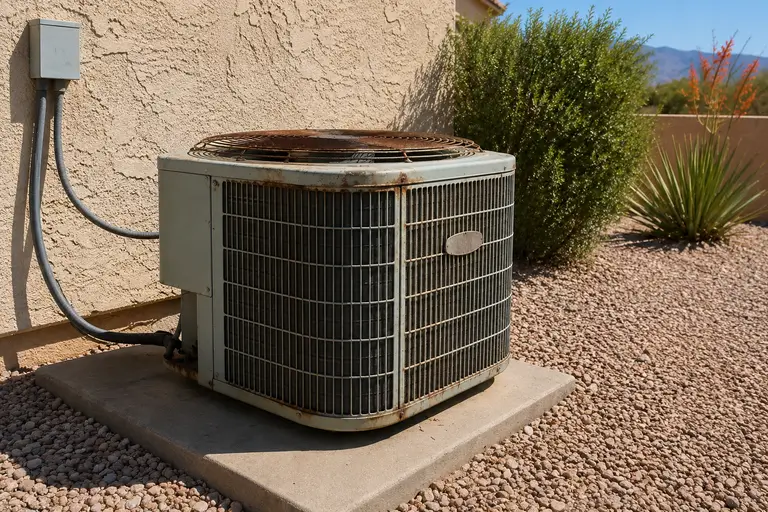
Here’s something a lot of Albuquerque homeowners genuinely don’t know: if your AC system is 15 or more years old, there’s a strong chance it runs on R-22 refrigerant — and R-22 was permanently banned from production and import in the United States on January 1, 2020 (EPA, 2020).
With production halted, only recycled and stockpiled R-22 remains available. Prices have spiked to $50–$100 or more per pound. Modern R-410A refrigerant, used in current systems, costs $5–$15 per pound by comparison. A typical recharge on a leaking R-22 system can cost $400–$1,000+ just for the refrigerant alone — before labor.
If a technician tells you your system needs refrigerant and it’s an older unit, ask one question before saying yes: “What refrigerant does this system use?” That answer changes everything. Pouring $600 worth of R-22 into a 16-year-old system isn’t a repair. It’s delaying the inevitable at a steep price.
3. Repairs Are Becoming Frequent or Expensive
The clearest decision-making tool for repair versus replace is the 5,000 rule: multiply the repair cost in dollars by the system’s age in years. If the result exceeds 5,000, replace.
- $400 repair on a 14-year-old unit: $400 × 14 = $5,600 – Replace
- $400 repair on a 6-year-old unit: $400 × 6 = $2,400 – Repair
This formula comes from consumer guidance long used by home warranty and HVAC industry advisors, and it holds up well in practice. It accounts for the fact that the same dollar repair on an aging system carries much more risk of repeat failure than on a newer one.
Two or more service calls in a single season is not bad luck. It’s a pattern. Each breakdown during a heat wave adds risk. Each repair costs money that could go toward a new system. AC repair in Albuquerque
4. Your Energy Bills Keep Climbing
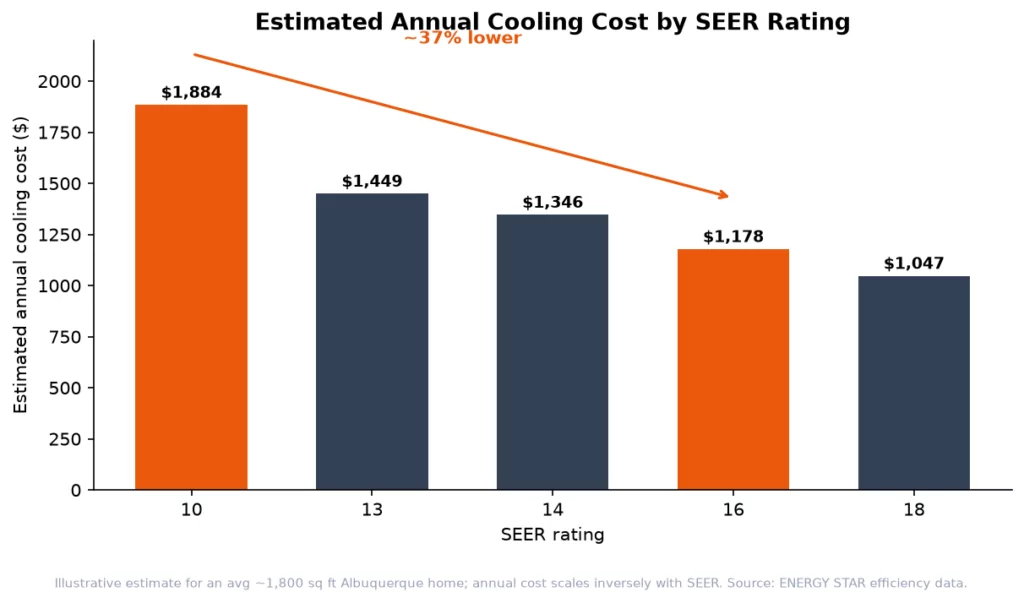
AC efficiency is measured in SEER (Seasonal Energy Efficiency Ratio). Higher SEER means more cooling per dollar of electricity. Systems installed before 2010 typically have a SEER rating of 8–10. In 2023, the federal minimum for the Southwest region — which includes New Mexico — rose to roughly 15 SEER (14.3 SEER2) for most residential systems, and high-efficiency options now reach 18–25 SEER (AHRI, 2023).
Upgrading from a 10 SEER unit to a 16 SEER unit reduces cooling energy use by approximately 37%. For a typical Albuquerque home running an older system through a full summer, that difference shows up clearly on your PNM bill every month from June through September. If your summer utility bills have been creeping up year over year without any clear reason, your system’s declining efficiency is the most likely culprit.
5. Your Home Isn’t Cooling Evenly
Hot spots in upstairs rooms or at the back of the house while the front stays comfortable are easy to dismiss as a quirk of your home’s layout. Sometimes that’s true. If your home has always had uneven cooling and you’ve never had it looked at, the issue may be in your duct design rather than the unit itself.
But if your home used to cool evenly and the imbalance has gotten worse over the past one to two seasons, that’s the system degrading. An aging compressor loses the ability to maintain consistent pressure and output across the full duct system. The result is rooms that the system simply can’t reach anymore. AC installation in Albuquerque
6. The System Runs Constantly But Can’t Keep Up
On a 100°F Albuquerque day, a properly sized, functioning system should cycle on and off to maintain your set temperature — typically 75–78°F. If your system runs continuously without ever reaching that target, one of two things is happening: the system is undersized for your home’s current load, or the compressor is failing.
Compressor replacement costs $1,200–$2,500 in parts and labor, depending on the unit. On a system that’s already 10 or more years old, spending that much to replace a single major component often doesn’t make financial sense. You’re investing heavily in a system that’s already near the end of its useful life, with other components likely to fail in the near future.
In our experience diagnosing systems across Albuquerque, a unit that runs nonstop during a 100°F day but can only hold 82°F indoors is rarely saved by a single repair. The compressor is usually the loudest symptom of a system that’s been under-performing for a while.
7. Strange Sounds, Smells, or Moisture Problems
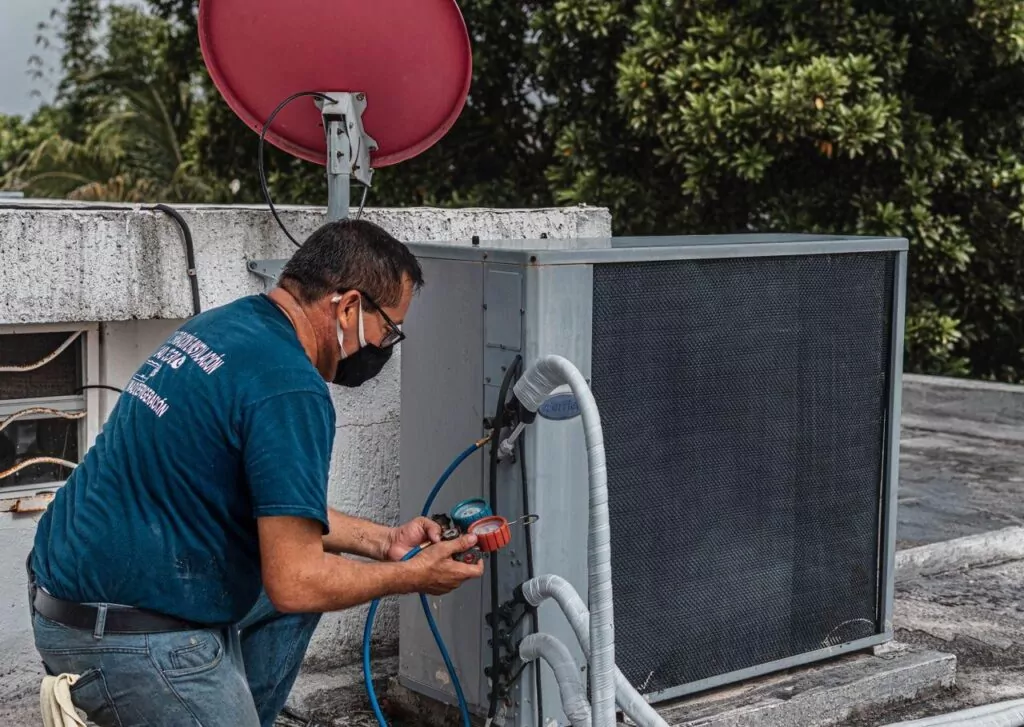
Your AC shouldn’t make noise beyond a steady operational hum and the click of the thermostat. It shouldn’t produce any smell. And it definitely shouldn’t be creating moisture problems around the air handler or in the ducts. Here’s what specific symptoms usually mean:
- Grinding, banging, or squealing: Mechanical failure — fan motor, blower wheel, or compressor bearing. These don’t resolve on their own.
- Burning smell: An electrical issue inside the unit. Shut the system off and call a technician before running it again.
- Musty smell: Mold or mildew in the air handler or evaporator coil. This is worth noting for ABQ specifically, because monsoon humidity arrives in July and August, creating conditions for coil moisture problems even in the desert.
- Sweet or chemical smell: Refrigerant leak. The EPA requires immediate attention — refrigerant exposure is a health concern, and a leaking system is both inefficient and potentially dangerous.
- Water pooling near the indoor unit: Often a clogged condensate drain line, which is usually a straightforward repair. On older units, it can also signal a degrading evaporator coil, which is a much costlier fix.
Any single one of these symptoms on a system under 8–10 years old is usually repairable. On a 12-plus-year-old system, they’re often the final confirmation that replacement is overdue.
AC Repair vs. Replacement: How to Decide
Use this table to cut through the guesswork. Every situation your aging system is likely to present fits into one of these categories.
| Situation | Recommendation |
| Unit is under 10 years old, single repair under $500 | Repair |
| Unit is under 10 years old, major repair (compressor, coil) | Get a quote and compare to replacement cost |
| Unit is 10–14 years old, repair cost × age exceeds $5,000 | Replace |
| Unit is 15+ years old, any significant repair needed | Replace |
| Unit uses R-22 refrigerant | Replace (refrigerant cost alone makes repair impractical) |
| Two or more repair calls this season | Replace |
The honest truth is that most homeowners who are reading a guide like this already know the answer. The system they’re describing has been on borrowed time. The table above just confirms what the repair bills have been hinting at for a season or two. HVAC repair costs in Albuquerque
AC Replacement Costs in Albuquerque [2026 Pricing]
Pricing for a new AC system in Albuquerque varies based on home size, duct condition, your existing electrical panel capacity, and the equipment brand. The table below gives realistic ranges for installed costs — unit plus labor, no hidden fees.
| System Type | Installed Cost (ABQ, 2026) |
| Central AC, 2-ton, 14 SEER | $4,500–$6,500 |
| Central AC, 3-ton, 14 SEER | $5,500–$7,500 |
| Central AC, 3-ton, 16–18 SEER | $6,500–$9,000 |
| Central AC, high efficiency, 20+ SEER | $8,500–$12,000+ |
| Ductless mini-split, single zone | $3,500–$6,000 |
| Swamp cooler conversion to central AC | $7,000–$14,000 |
Beyond Heating and Cooling provides written upfront quotes before any work begins. No surprises after the fact.
Worth noting: the higher up-front cost of a 16–18 SEER system versus a 14 SEER baseline often pays back within five to eight years through lower monthly energy costs. When you factor in PNM rebates, that payback timeline shortens further. swamp cooler vs central AC
How PNM Rebates and Financing Reduce Your Replacement Cost
The sticker price on a new AC system is rarely what Albuquerque homeowners actually end up paying. A couple of financial tools can meaningfully reduce the out-of-pocket cost, and most homeowners don’t take full advantage of them.
PNM rebates: Public Service Company of New Mexico offers rebates for qualifying high-efficiency AC equipment, typically at 16 SEER or higher. Rebate amounts and eligibility requirements change periodically, so confirm current availability with your HVAC contractor or check PNM’s current rebate portal directly. Your contractor should be familiar with the application process and can often handle the paperwork on your behalf.
A note on federal tax credits: The federal Energy Efficient Home Improvement Credit (Section 25C), which previously offered up to $600 for a qualifying central AC and up to $2,000 for a heat pump, expired on December 31, 2025 (IRS Energy Credits). Systems installed in 2026 and later no longer qualify for that federal credit. If you’ve heard about the 30% IRA credit, that’s why it may no longer apply — but PNM and manufacturer rebates can still help.
Synchrony financing: Beyond Heating and Cooling offers Synchrony financing, which means you don’t have to pay for a full system replacement in a single lump sum. Spread the cost over manageable monthly payments and avoid the choice between a working AC this summer and your savings account.
Between rebates and financing, a new high-efficiency system is more financially accessible than most homeowners expect going in.
If Your System Is Showing Two or More of These Signs, Don’t Wait
Albuquerque doesn’t offer a forgiving window for AC failure. June through September is peak heat, and a complete breakdown on a 105°F afternoon means same-day service calls, potential after-hours rates, and hours without cooling while you wait.
If your system is checking two or more boxes from the list above — especially if it’s over 12 years old, uses R-22, or has already needed repairs this season — the question isn’t whether to replace it. It’s whether to replace it before it fails on the worst possible day or after.
Call Beyond Heating and Cooling at 505-569-6939 for a free AC assessment. Our NATE-certified technicians will give you an honest recommendation — repair or replace — with upfront written pricing either way. We serve Albuquerque, Rio Rancho, Santa Fe, and Los Lunas with same-day availability during peak season.
Ready to get a quote or schedule an assessment? Visit our contact page or learn more about AC repair in Albuquerque.
Frequently Asked Questions
How long does AC replacement take in Albuquerque?
Most standard central AC replacements take four to eight hours from start to finish. Beyond Heating and Cooling offers same-day service for qualifying installations, so you’re not sleeping through a July heat wave waiting for a next-week appointment. Complex installs — like a swamp cooler conversion — may take one to two days.
What size AC do I need for my Albuquerque home?
Square footage is a starting point, not the answer. Proper sizing requires a Manual J load calculation, which accounts for your home’s insulation levels, window area and orientation, ceiling height, and local climate data (DOE Building Technologies Office, 2024). An oversized system short-cycles, leaving humidity problems and uneven cooling. An undersized system runs constantly and can’t hit setpoint. NATE-certified technicians perform Manual J calculations as part of any replacement quote.
Should I replace my furnace at the same time as my AC?
If your furnace is also 12 or more years old, replacing both at the same time saves on labor costs and ensures the two systems are properly matched for efficiency. A new high-efficiency AC paired with an aging furnace blower can underperform because the airflow and static pressure specs don’t align. Ask your technician to assess the furnace during the AC consultation.
What about a heat pump instead of a traditional AC?
Albuquerque’s mild winters make heat pumps a practical option. A heat pump handles both cooling in summer and heating in winter from a single system. Modern cold-climate heat pumps perform efficiently even on nights that dip below freezing. Replacing both your heating and cooling with one system can also simplify maintenance and improve overall efficiency, so it’s worth running the comparison against a traditional AC-plus-furnace setup with your technician.
Will a new AC actually save me money on my PNM bill?
Yes, with specific numbers to back that up. Replacing a 10 SEER system with a new 16 SEER unit cuts cooling energy use by approximately 37% (ENERGY STAR, 2025). At typical ABQ summer electricity rates across a four-month cooling season, that reduction usually represents $200–$400 in annual savings for an average home. Over a 5–8 year payback period, the system pays for a meaningful portion of itself through lower utility costs.