
When you realize your AC is blowing warm air, that initial wave of heat is usually followed by a wave of stress. In our high-desert climate, where dust and extreme heat put immense strain on cooling systems, a small drop in performance can quickly escalate into a total system breakdown. Understanding why your air conditioner isn’t cooling as it should is the first step toward restoring your home’s comfort.
Let’s walk through what might be happening with your unit if the AC is not blowing cold air and why timely repair in Albuquerque is the smartest way to protect your investment.
Is It Normal for an AC to Blow Warm Air?

It’s not uncommon for an AC to occasionally blow warm air, especially during startup. When your system first kicks on, the air sitting in your ductwork has been warmed by the ambient temperature of your attic or crawlspace. It takes a moment for the refrigerated air to push that stagnant air out. However, if the system is blowing warm air for more than a minute or two, or if the air never actually reaches a cool temperature, you are dealing with a malfunction.
When Warm Air Means Immediate Attention Is Needed
Ignoring the problem doesn’t just mean a sweaty afternoon; it can physically damage the heart of your unit. If you notice the air temperature rising, check for these three red flags that require a quick response:
- A Hissing Sound: This often points to a high-pressure refrigerant leak.
- Rapid Cycling: The unit turns on and off every few minutes, but it doesn’t cool the house.
- Hot Air from the Vents: If the AC is blowing hot air (warmer than the room temperature), your compressor may be overheating.
Common Reasons Your AC Is Blowing Warm Air
When a central air system is not cooling, the culprit is often a disruption in the heat-exchange process. Your AC doesn’t actually create cold; it removes heat. If any part of that cycle is broken, the heat stays right where you don’t want it.
Why Even Small Issues Can Cause Big Cooling Problems
It is easy to think a dirty part isn’t a broken part, but in the world of HVAC, dirt is a mechanical failure. In Albuquerque, our wind-blown dust is a constant enemy.
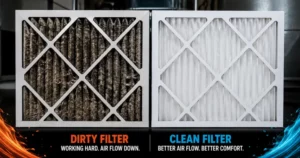
- Clogged Air Filters: This is the most common reason for warm air. When air can’t flow through the filter, the cooling coils get too cold and eventually freeze over, blocking all cooling.
- Dirty Condenser Coils: Your outdoor unit needs to breathe to release the heat it gathered from inside. If it’s covered in dirt, hair, or debris, that heat stays trapped in the line.
- Thermostat Miscommunication: Sometimes, the system’s brain is simply telling the muscles the wrong information. A faulty sensor or a dead battery can cause the unit to blow air without engaging the cooling cycle.
Refrigerant Problems and Cooling Performance
Refrigerant is the lifeblood of your cooling system. It is a closed-loop system, meaning your AC should never run out of refrigerant. If the levels are low, it means you have a leak.
Signs of Refrigerant-Related Issues
If your AC isn’t blowing cold air and ice is forming on the copper lines (even if it’s 100°F outside), you likely have a refrigerant issue. Low pressure causes the coils to drop below freezing, turning humidity into ice and insulating the coils so they can’t absorb heat.
If you notice bubbling sounds or see oily residue around the line connections, do not try to repair them yourself. Refrigerant requires specialized handling and precise measurements. Continuing to run a system with low refrigerant will eventually burn out the compressor, turning a simple leak fix into a full system replacement.
Electrical or Mechanical Failures to Watch For
Sometimes the issue is deeper than a filter or a leak. Your AC is a complex web of high-voltage electricity and high-pressure mechanics.
Why Central Air Not Cooling Often Requires Professional Diagnosis
When your central air is not cooling, the problem might be an electrical component that has reached its limit.
- The Capacitor: This is essentially a giant battery that gives your compressor the kick it needs to start. Albuquerque’s heat is notorious for frying capacitors. If you hear a humming sound but the fan isn’t spinning, this is likely the cause.
- Fan Motor Failure: If the indoor blower or outdoor fan stops, heat can’t be moved.
- Control Board Issues: The internal computer may have a short circuit, preventing communication among the different stages of the cooling process.
Because these issues involve high-voltage components, DIY troubleshooting is dangerous. A professional repair ensures the electrical integrity of your home remains intact while the cooling is restored.
When to Call for AC Repair in Albuquerque

Albuquerque presents a unique challenge for HVAC systems. We have high altitudes, intense UV rays that degrade outdoor components, and a pervasive caliche dust that can cement itself into your unit.
Benefits of Hiring a Local AC Repair Professional
When your AC is blowing hot air, you don’t just need a technician; you need someone who understands the local environment. A local professional knows which parts tend to fail in our 5,000-foot altitude and which brands hold up best against the New Mexico sun. They offer:
- Fast Response Times: Local teams are already in your neighborhood (from Nob Hill to the Westside), minimizing the time you spend in a hot house.
- Specific Climate Knowledge: They understand how our low humidity affects evaporation in the cooling cycle.
- Specialized Equipment: They carry the specific filters and capacitors that are standard for homes in the Rio Grande Valley.
Restore Cool Comfort Before the Problem Gets Worse
If an air conditioner is not cooling is your current reality, the best time to act was yesterday (the second-best time is now). Taking a proactive approach prevents a domino effect where a $50 part failure leads to a $3,000 compressor replacement.
Before you call, do a quick check: Is the thermostat set to Auto and Cool? Is the air filter clean? Is the circuit breaker flipped? If those basics are covered and the AC is blowing warm air, it is time to bring in the experts. Restoring your system doesn’t just improve your comfort; it protects your home’s air quality and ensures your energy bills stay manageable during the peak of summer.
To ensure your home stays a sanctuary against the desert heat, talk to a certified cooling technician today. We specialize in fast, reliable AC repair in Albuquerque to get your home back to the temperature it should be.
Frequently Asked Questions
1. Why is my AC running, but the air coming out isn’t cold?
This is often a sign of a split failure. Your indoor fan might be working fine (blowing air), but the outdoor unit (the condenser) might not be running at all. This could be due to a tripped breaker, a blown capacitor, or a thermostat issue. If the outdoor unit isn’t humming, it can’t move heat out of the house, leaving you with lukewarm air circulation.
2. Can Albuquerque’s dust actually cause my AC to blow warm air?
Absolutely. In Albuquerque, we deal with significant dust and cottonwood debris. When this material coats your outdoor coils, it acts like a thermal blanket. The heat that your AC pulls from inside your home can’t escape into the outside air. The system then recirculates that heat, leading to a situation where your AC won’t work despite the motor running at full speed.
3. What does it mean if my AC is blowing warm air and the indoor unit is hissing?
A hissing sound usually indicates a refrigerant leak. Refrigerant is a gas at certain stages of the cooling cycle, and a leak allows that gas to escape under high pressure. If you hear this, turn the system off immediately. Running an AC with a refrigerant leak puts extreme stress on the compressor and can lead to a total mechanical failure.
4. Is it safe to keep running my AC if it isn’t cooling properly?
It is not recommended. If your air conditioner is not working due to a mechanical or electrical issue, powering through can cause a chain reaction. For example, a failing fan motor can cause the compressor to overheat and seize. It is always more cost-effective to shut the system down and call for AC repair than to risk a total system replacement.
5. Why does my AC blow cold air at night but warm air during the day?
This usually suggests that your system is undersized or inefficient. During the night, the heat load on your house is lower, so the struggling system can keep up. Once the Albuquerque sun hits your roof, the heat gain exceeds the AC’s ability to remove it. This could be due to low refrigerant, dirty coils, or an aging system that has lost its cooling capacity.