It’s the cheapest, most-skipped piece of HVAC maintenance there is — a $10 to $30 part that, ignored, can choke your system, spike your bills, and even cause a breakdown. So how often should you actually swap it? And in dusty, windy Albuquerque, does the usual advice even apply?
Here’s the straight answer, the local adjustment, and how to pick the right filter while you’re at it.
Key Takeaways
- ENERGY STAR recommends checking your filter monthly and changing it at least every 3 months (ENERGY STAR, 2026).
- In Albuquerque, dust, wind, and pets push most homes to the shorter end — every 30 to 60 days.
- For better filtration, the EPA suggests MERV 13, or as high as your system can handle (US EPA, 2026).
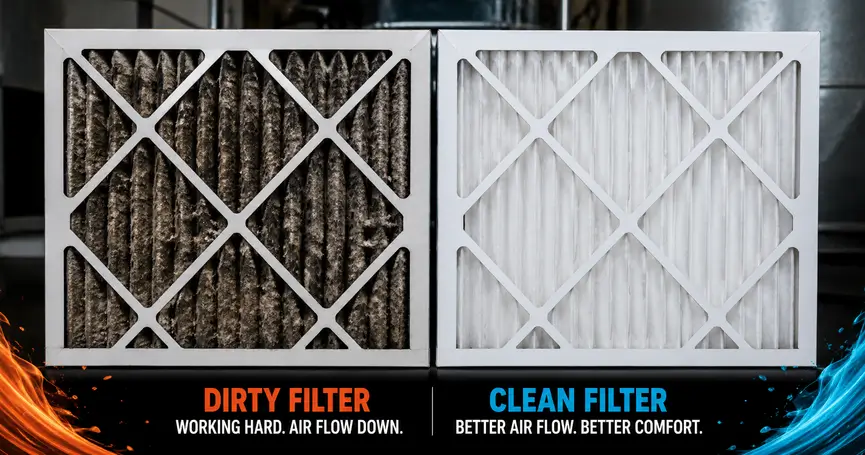
- A clogged filter strains the system, raises energy bills, and is a leading cause of “my AC isn’t cooling” service calls.
How Often Should You Change Your Air Filter?
Check it monthly, and change it at least every three months. That’s the ENERGY STAR guidance: inspect, clean, or change the filter in your air conditioner, furnace, or heat pump once a month, and swap it at a minimum every 90 days (ENERGY STAR, 2026). The monthly check matters because filters don’t load up on a neat schedule — a dusty stretch can clog one in weeks.
The “every 3 months” figure is a floor, not a target. It assumes an average home in average conditions. Thicker filters (the 4- and 5-inch media in a dedicated cabinet) last longer than the standard 1-inch panel, and a home with pets, allergies, or heavy dust needs changes more often. The right cadence for your house depends on your filter and your air — which is exactly why the monthly look is the habit worth building.
Why Albuquerque Homes Need to Change Filters More Often
Because our air is working against you. Albuquerque sits in a high-desert basin with spring winds that kick up dust, blowing sand, and construction grit, plus monsoon-season pollen and mold spores in late summer. All of it ends up in your return air and, from there, your filter. A filter that might last 90 days in a mild, humid climate often loads up here in 30 to 45.
Add a pet or two and the math gets shorter still. The national “change it every 90 days” default is built for average conditions — and Albuquerque’s dust load isn’t average. For most local homes, a check every month and a change every 30 to 60 days is the realistic rhythm. It’s a small habit that protects a very expensive machine.
What Is a MERV Rating (and Which Should You Use)?
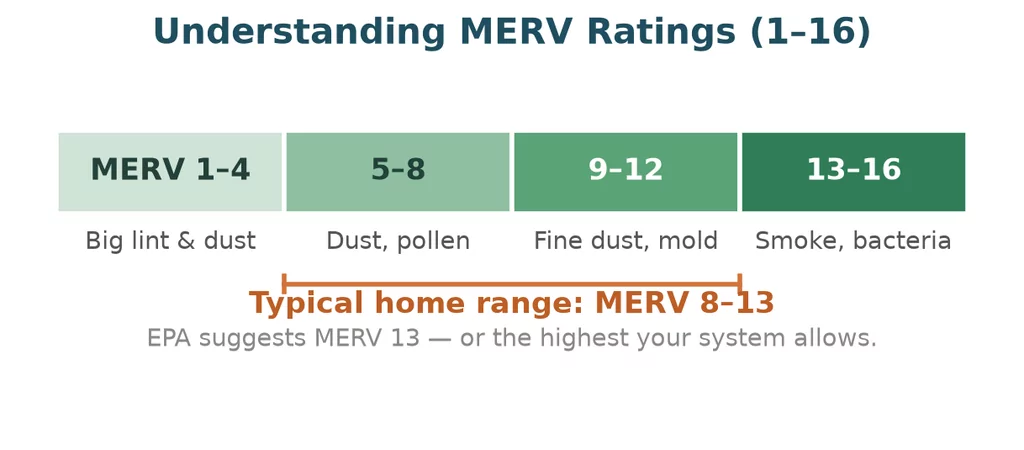
MERV tells you how fine a filter’s mesh is — the higher the number, the smaller the particles it traps. MERV stands for Minimum Efficiency Reporting Value, and the scale runs from 1 to 16 for residential and light-commercial filters, rating how well they capture particles between 0.3 and 10 microns (US EPA, 2026). A low-MERV fiberglass filter stops big lint and dust; a high-MERV pleated filter catches fine dust, pollen, and smoke.
So higher is always better, right? Not quite. The EPA advises that if you upgrade, you choose at least MERV 13 — or as high a rating as your system’s fan and filter slot can accommodate (US EPA, 2026). That last part is the catch: a filter that’s too dense for your blower restricts airflow, which strains the system and can actually hurt performance. The goal is the highest MERV your equipment is designed to handle, not the highest number on the shelf.
When does a higher MERV make sense? If someone in your home has allergies, asthma, or sensitivity to smoke — including the wildfire smoke that drifts into New Mexico some summers — stepping up to MERV 13 (in a system that can handle it) captures far finer particles. If nobody’s especially sensitive and your system is older, MERV 8 to 11 keeps airflow strong while still trapping the dust that matters most here. Match the filter to both your air and your equipment.
How Often to Change by Filter Type, Pets & Dust
The right interval scales with filter thickness and your home’s air. As a rule, thin filters and dirty air mean more frequent changes; thick filters buy you time. The chart below shows realistic Albuquerque intervals — and remember, these shorten with pets, allergies, or a windy, dusty stretch.
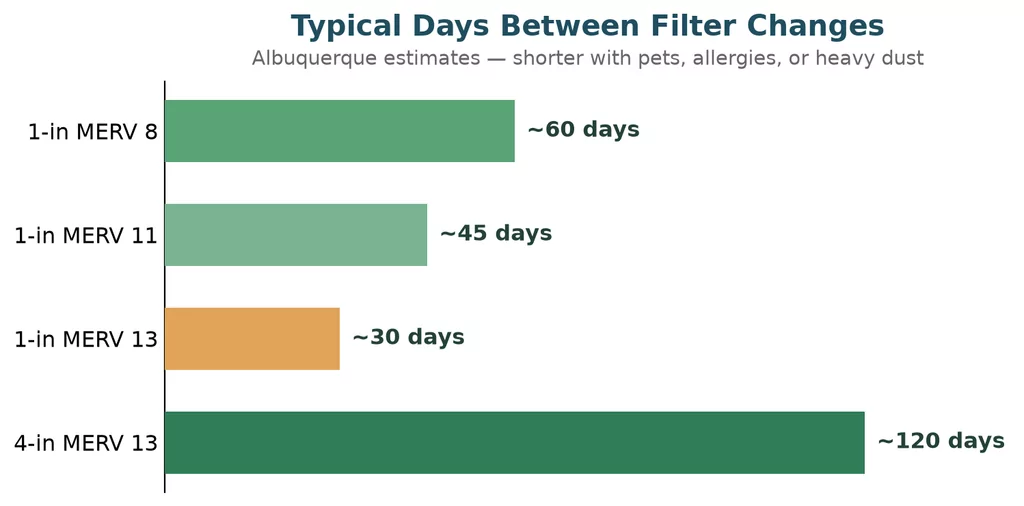
If you have pets, run the shorter end — every 30 to 60 days for a standard pleated filter. Heavy shedders or multiple pets? Closer to 30. And if anyone in the house has allergies or asthma, a fresh filter isn’t just about the equipment — it’s about the air you breathe.
The hardest part usually isn’t the change — it’s remembering. Set a monthly phone reminder to check the filter, and keep a spare or two of the right size on hand so a dirty filter never waits on a hardware-store run. Some homeowners buy a multi-pack and write the install date right on each frame with a marker. Whatever system works for you, the goal is simple: never let a clogged filter just sit there.
Signs Your Filter Needs Changing Now
Don’t wait for the calendar if the symptoms show up first. A filter that’s overdue announces itself in a few ways, and catching it early saves both comfort and money.
Watch for weaker airflow from the vents, dust settling on surfaces faster than usual, a system that runs longer to hit the same temperature, rising energy bills, or allergy symptoms flaring indoors. That last-longer-to-cool symptom is a big one in summer: a clogged filter starves the system of airflow, and it’s one of the most common reasons behind an AC that’s blowing warm air. More than a few “my AC is broken” calls turn out to be a $15 filter.
How to Change Your Filter (and Find the Right Size)
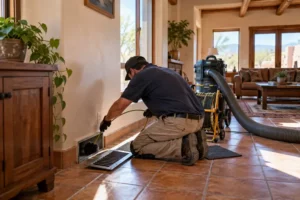
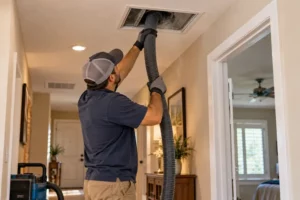
It takes about two minutes once you know where the filter lives and what size you need. The filter sits in the return — either in a slot on the furnace/air handler or behind a return-air grille on a wall or ceiling.
To swap it: turn the system off, slide the old filter out, and note the size printed on its cardboard frame (something like 16x25x1) and the airflow arrow. Buy the same size, slide the new one in with the arrow pointing toward the furnace or air handler (the direction of airflow), and turn the system back on. Snap a photo of the size so you never guess again. Want it handled for you along with a full check-up? A tune-up and maintenance visit covers filters and a lot more — call (505) 569-6939.
The Bigger Picture: Filters, Air Quality & Your System
A filter’s real job is two jobs. It protects your HVAC equipment from dust that would gum up the blower and coil, and it helps clean the air your family breathes. Neglect it and you lose on both fronts — efficiency and air quality — which is why filters are step one in almost any indoor air quality conversation. For the whole-home picture, pairing regular filter changes with a seasonal maintenance plan keeps everything running clean.
Think of the filter as the entry point to healthier air. A fresh one won’t fix every air-quality problem — some issues call for duct cleaning, humidity control, or dedicated air purification — but it’s the first and cheapest step, and skipping it undermines everything downstream.
Frequently Asked Questions
How often should I change my HVAC filter?
Check it monthly and change it at least every 3 months, per ENERGY STAR (ENERGY STAR, 2026). In Albuquerque, plan on the shorter end — every 30 to 60 days for a standard 1-inch pleated filter — because local dust and wind load filters faster than the national average.
What MERV rating is best for a home?
The EPA suggests at least MERV 13, or as high a rating as your system’s fan and filter slot can accommodate (US EPA, 2026). Most homes do well in the MERV 8–13 range. Going higher than your equipment is designed for restricts airflow and can hurt performance, so match the filter to your system.
Can a dirty air filter raise my energy bill?
Yes. A clogged filter restricts airflow, so the system runs longer and works harder to reach the set temperature — which uses more energy. It can also cause the AC coil to freeze or the furnace to overheat, turning a cheap filter into an expensive repair.
How often should I change the filter with pets?
Every 30 to 60 days for a standard pleated filter. A single short-haired pet may be fine at 60 days; multiple or heavy-shedding pets push it toward 30. Pet dander and hair load a filter quickly, and it affects indoor air quality as much as the equipment.
What happens if I never change my air filter?
Airflow drops, the system strains, and bills climb. Eventually you risk a frozen evaporator coil in summer, an overheated furnace in winter, and premature wear on the blower — plus dirtier indoor air. It’s the cheapest failure to prevent and one of the most common we see.
The Bottom Line
Check your filter monthly, change it every 30 to 60 days in dusty Albuquerque (90 at the outside), and match the MERV rating to what your system can handle. It’s the least expensive, highest-return maintenance habit you have — and it prevents a surprising number of summer breakdowns.
Want filters handled as part of a seasonal check-up? Call Beyond Heating & Cooling at (505) 569-6939 or ask about our maintenance plans.
Sources
- ENERGY STAR, “Maintenance Checklist,” retrieved 2026-07-15, https://www.energystar.gov/saveathome/heating-cooling/maintenance-checklist
- U.S. Environmental Protection Agency, “What is a MERV rating?”, retrieved 2026-07-15, https://www.epa.gov/indoor-air-quality-iaq/what-merv-rating