A heat pump heats and cools your home from one electric system, suited to high-desert houses that need both in the same week. Miguel Garcia, owner of Beyond Heating and Cooling, wrote this for Albuquerque-area homeowners weighing an install. Heat pumps are part of our residential heating services. This guide covers how one handles local winters, where it falls short and what sets its price.
Key Takeaways
- Cold Albuquerque nights are no reason to pass on a heat pump, because the dry desert air helps the system rather than working against it.
- Have your ductwork and electrical service looked over before you commit, since either one may need work before a heat pump goes in.
- Expect gentler, longer-running warmth than a furnace gives, and decide whether that steadier feel suits your household before you make the switch.
What Is a Heat Pump, and How Does It Work?
A heat pump is an electric system that heats and cools your home by moving heat instead of making it. A furnace burns gas or runs current through coils to make warmth, while a heat pump moves warmth that is already there.
How the Refrigerant Cycle Moves Heat
Cold air still holds heat. Refrigerant in the outdoor coil absorbs it, the compressor concentrates it, and the indoor coil releases it into your ducts. In summer the cycle runs in reverse, pulling heat from your rooms and releasing it outside, so one unit replaces both a furnace and a separate air conditioner installation.
Which Benefits Does Heat Pump Installation Bring to Bills and Comfort?
A heat pump lowers running costs and keeps room temperatures steadier. Rewiring America lists lower energy bills among the gains of switching, and your own result depends on what you heat with now and how well the house holds heat.
The savings come from the physics. A furnace turns fuel into heat once and is done. A heat pump spends its electricity moving heat, so each unit of power delivers more warmth than it uses, and the gap is widest for homes coming off electric baseboard or propane.
| Benefit | What changes at home |
|---|---|
| Lower bills | Moving heat takes less energy than making it |
| Steadier comfort | Long, gentle cycles replace short blasts of hot air, so you get fewer cold spots |
| No combustion indoors | No gas burns inside the house for heat |
| One system, two jobs | One outdoor unit and one indoor coil replace a furnace and a separate AC |
| Simpler upkeep | One maintenance visit covers both your heating and cooling equipment |
Steadier cycles also mean less overshoot. Rooms sit closer to the thermostat setting instead of swinging warm, then cool, then warm again.
If you would rather stay with gas heat, our furnace installation work is the other route.
Do Heat Pumps Work Well in Albuquerque’s Climate?
Yes. In Albuquerque, our homes have to work twice as hard, and the dry high-desert air works in a heat pump’s favor. In summer there is little moisture to pull from the house, so more of the cooling effort goes into lowering the temperature.
Winter brings a second advantage. The outdoor coil frosts over less often, which means fewer defrost cycles, the short reversals that melt ice off the coil.
Will a Heat Pump Keep Up With Albuquerque Winters?
It will, when the model is picked for cold weather. A heat pump’s output falls as the outdoor temperature drops, so compare each model’s rated heating capacity at low temperatures, not only its efficiency rating. Cold-climate models are built to keep heating where older designs fall behind. A load calculation for your house shows how much heat it loses on a cold night, which is the number that model’s low-temperature capacity has to meet.
What Types of Heat Pumps Are There?
Heat pumps differ in where they draw heat from and how they deliver it. The right one depends on your ducts and your yard.
Air-Source Heat Pumps
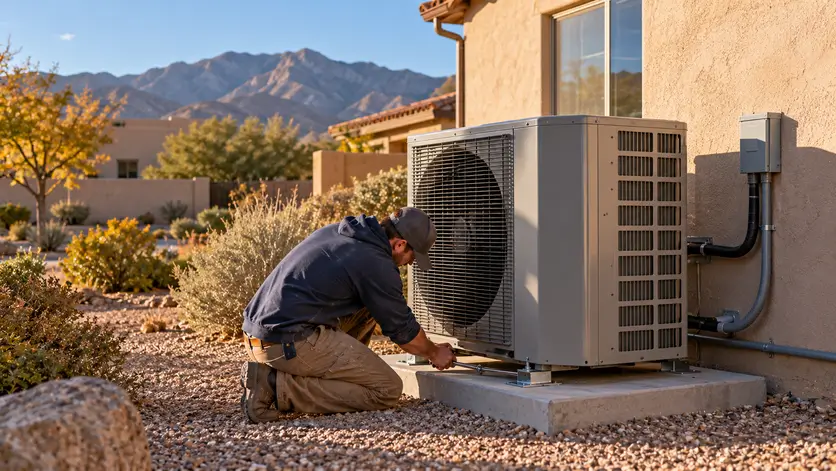
An air-source heat pump trades heat with the outdoor air. The ducted version ties into the supply and return ducts your furnace already uses. If those ducts are sealed and sized for its airflow, the swap is straightforward. Leaky or undersized runs need fixing first.
Ductless Mini-Split Heat Pumps
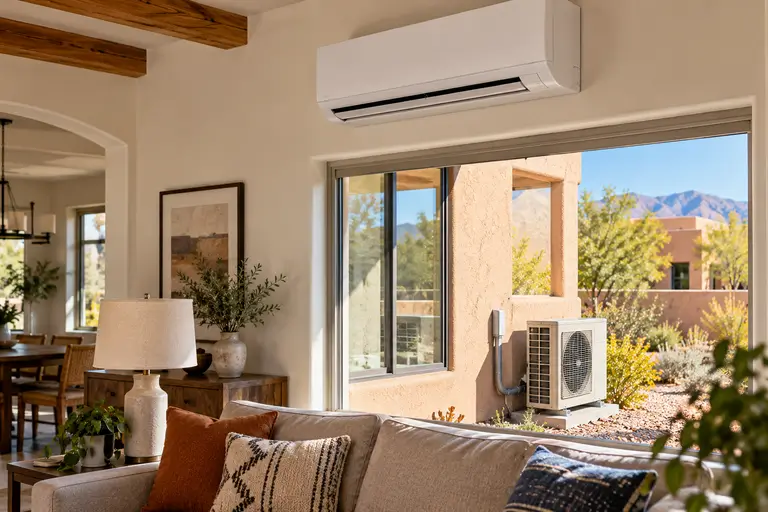
A mini-split is air-source without the ducts. One outdoor unit feeds one or more wall or ceiling heads through a refrigerant line set passed through a small opening in the wall. Each head has its own controls, so you can heat a home office without warming empty bedrooms. It suits houses built without ducts, and additions where extending ductwork would mean opening walls.
Ground-Source (Geothermal) Heat Pumps
A ground-source system trades heat with the earth through pipe buried in trenches or drilled bores. The ground’s temperature swings far less than the air’s, which eases the system’s work.
The loop is the hurdle, since it needs room on the lot and digging the other types never require. Researchers at the University of Michigan’s Center for Sustainable Systems studied the barriers to geothermal systems in U.S. homes alongside the environmental and economic benefits. It makes most sense in new construction or a major renovation, when the ground is already open.
Is Heat Pump Installation Right for Your Home?
A heat pump suits your home when its ducts and electrical service can carry one, or when you are ready to upgrade them. Carrier notes that older homes may need electrical upgrades or ductwork repairs before a heat pump goes in. If your furnace has years left and only cooling needs replacing, air conditioning installation alone is the smaller job.
Licensed, Insured and Family-Operated Since 2018
Beyond Heating and Cooling has been family-operated since 2018. We install heat pumps, furnaces and air conditioners for homeowners in Albuquerque, Los Lunas, Rio Rancho, Santa Fe, Los Ranchos, Placitas, Moriarty and Edgewood. That means every option above comes from one contractor.
You can send us questions about your specific house.
The Downsides to Weigh Before You Install One
The trade-offs to weigh are how the heat feels and what the system needs around it. Heat pump air leaves the registers warm rather than hot, so after a furnace’s blast, rooms can feel slower to warm.
The outdoor unit runs all winter. It needs open airflow, clear of shrubs and drifting snow. Backup heat strips, electric coils that help on the coldest nights, also cost more to run than the heat pump itself.
Heat Pump Vs. a Furnace, Swamp Cooler or Central AC
The difference is which jobs each system covers. A furnace only heats, so cooling means a second system. A swamp cooler, or evaporative cooler, cools by adding moisture to the air and gives no heat. It needs a water supply, and its effect fades when outdoor air turns humid. Central AC cools with refrigerant the same way a heat pump does in summer.
If cooling is your only decision, weigh a swamp cooler against central AC first.
What Drives the Cost of a Heat Pump Installation
The price comes from your house. A larger home needs more capacity, and a cold-climate model costs more than a basic one. Backup heat strips or a gas backup add parts and labor, and so does a new refrigerant line set when the old one cannot be reused.
Send us your plans and request a written, itemized scope, so each item shows on its own line. Financing is available. For yours, contact us or call (505) 382-1344.
Frequently Asked Questions
Can heat pumps handle Albuquerque’s coldest winter nights?
For the nights a heat pump cannot cover alone, we can install supplemental heat strips or a hybrid gas backup, where a gas furnace takes over the heating once outdoor temperatures drop too low.
How much does a heat pump cost compared to a furnace/AC combo?
Often less. Buying and installing one heat pump can cost less than a new furnace plus a new central air conditioner, and afterward you have one system to maintain instead of two.
How long do heat pumps typically last in New Mexico?
Carrier estimates that a well-maintained heat pump typically lasts 10 to 15 years, a national figure. Here, coil cleaning matters, since dust coating the coils makes the system work harder for the same output.
Are heat pumps noisy during operation?
Indoors, a heat pump is quiet. Most of the sound comes from the outdoor unit’s fan and compressor, and variable-speed models ramp up gradually instead of starting at full power.
Can I use my existing ductwork for a heat pump installation?
Usually, yes, if the house has central ducts now. The check should cover the return side as well as the supply runs, because a heat pump needs steady airflow across its indoor coil to heat and cool properly.
Can a heat pump cool a house in 100-degree weather?
Yes, when it is sized for your house’s cooling load. Output drops as the outside air gets hotter, so check the model’s rated cooling capacity at high outdoor temperatures and size it from a load calculation for your house.
Why is my electric bill so high with a heat pump?
Backup heat strips running in place of the heat pump drive bills up, so check the thermostat is not left on emergency heat (the setting that runs only the strips). If you came off gas, heating now shows on the electric bill.
Why do some people say heat pumps aren’t the future?
Two objections come up: the upfront price and doubts about heating in deep cold. Rewiring America says heat pumps cost slightly more upfront than a traditional furnace, but notes money is available to help close that gap. ENERGY STAR explains which air-source heat pumps qualify for the federal tax credit and its current terms, so check there before you price a model.
Sources
- Air Source Heat Pumps Tax Credit | ENERGY STAR, ENERGY STAR / U.S. Department of Energy, retrieved 2026-10-05.
- Geothermal Heat Pump System for U.S. Residential Houses: Barriers of Implementation, css.umich.edu, retrieved 2026-10-05.
- How Much Does a Heat Pump Cost? | 2026 Price Guide, Carrier Corporation, retrieved 2026-10-05.
- The pros and cons of heat pumps | Rewiring America Electrification Planner, homes.rewiringamerica.org, retrieved 2026-10-05.